
Last updated September 20, 2026
Full 25-point door and opener safety check with every visit - springs, cables, rollers, tracks, and your LiftMaster or Chamberlain opener included
You get a price before we start. It does not change when the truck arrives.
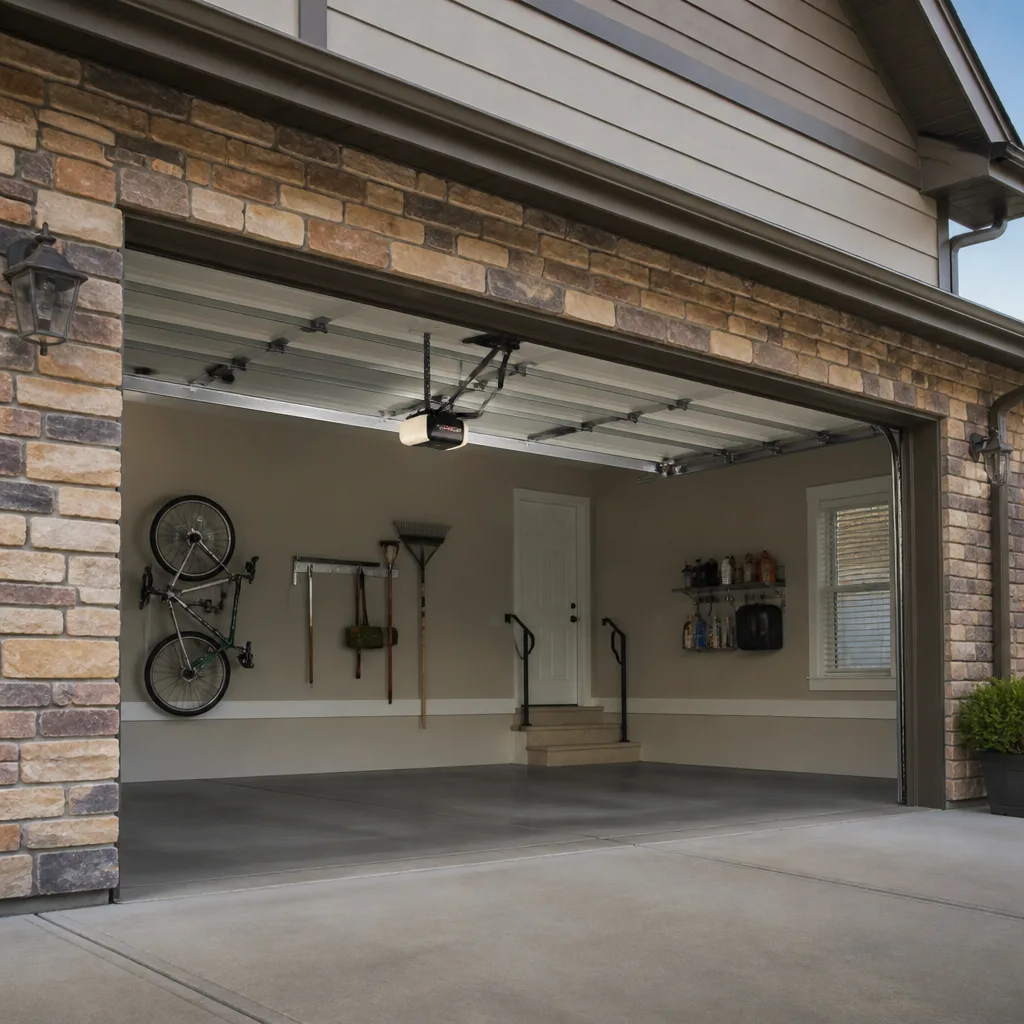
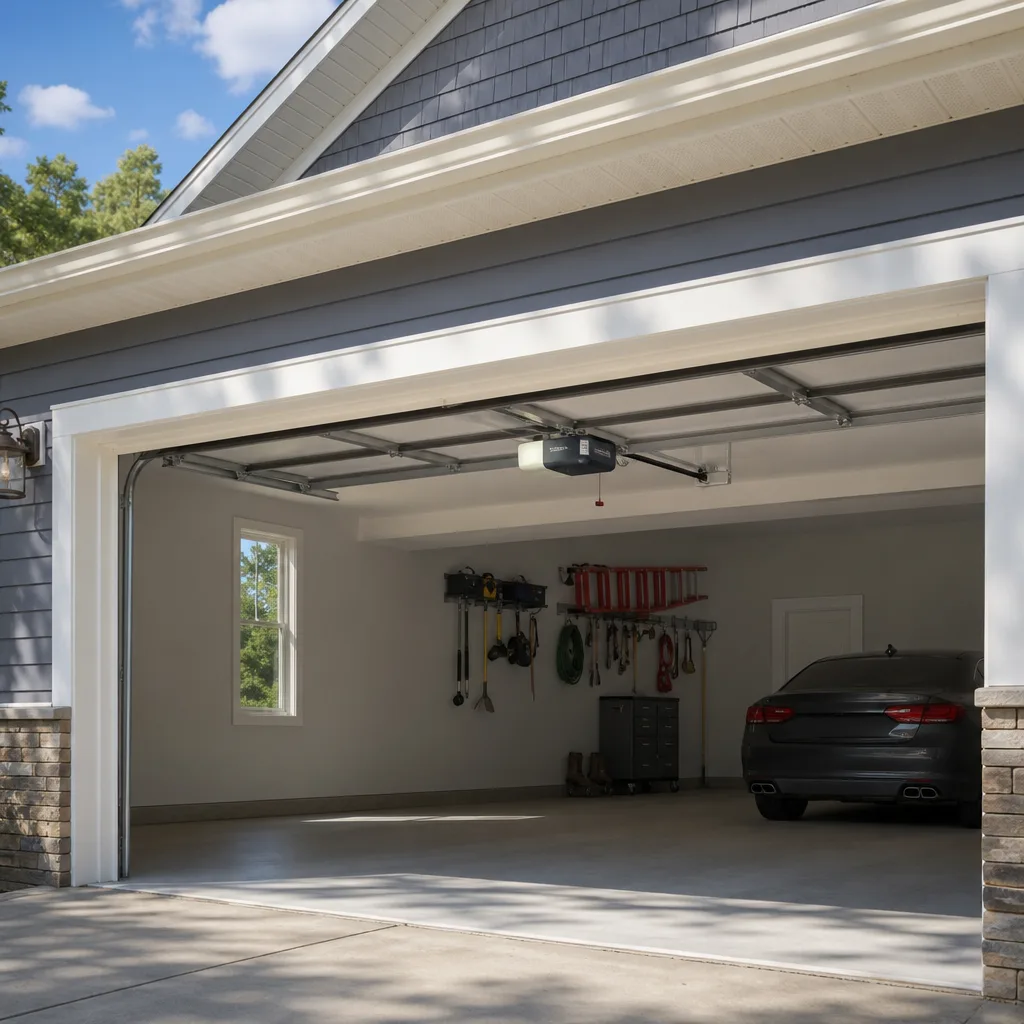
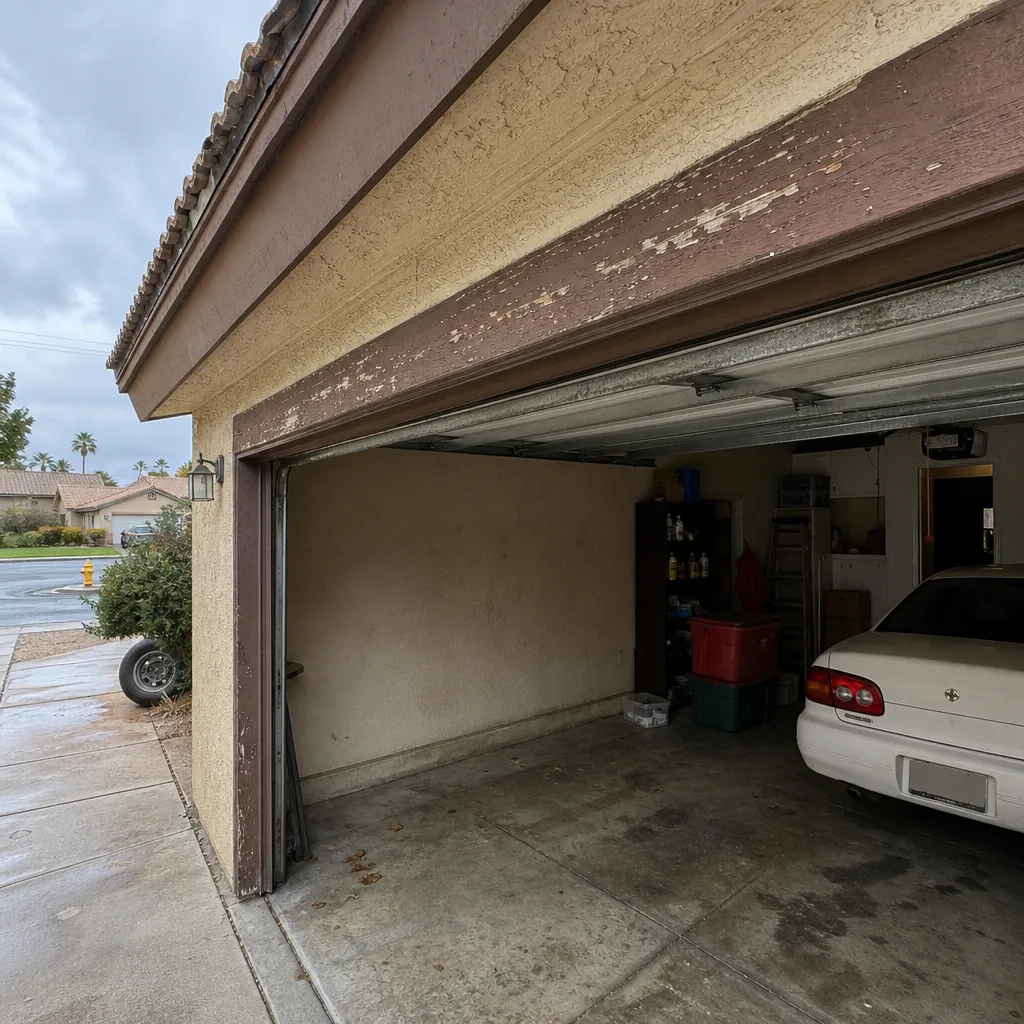 Before
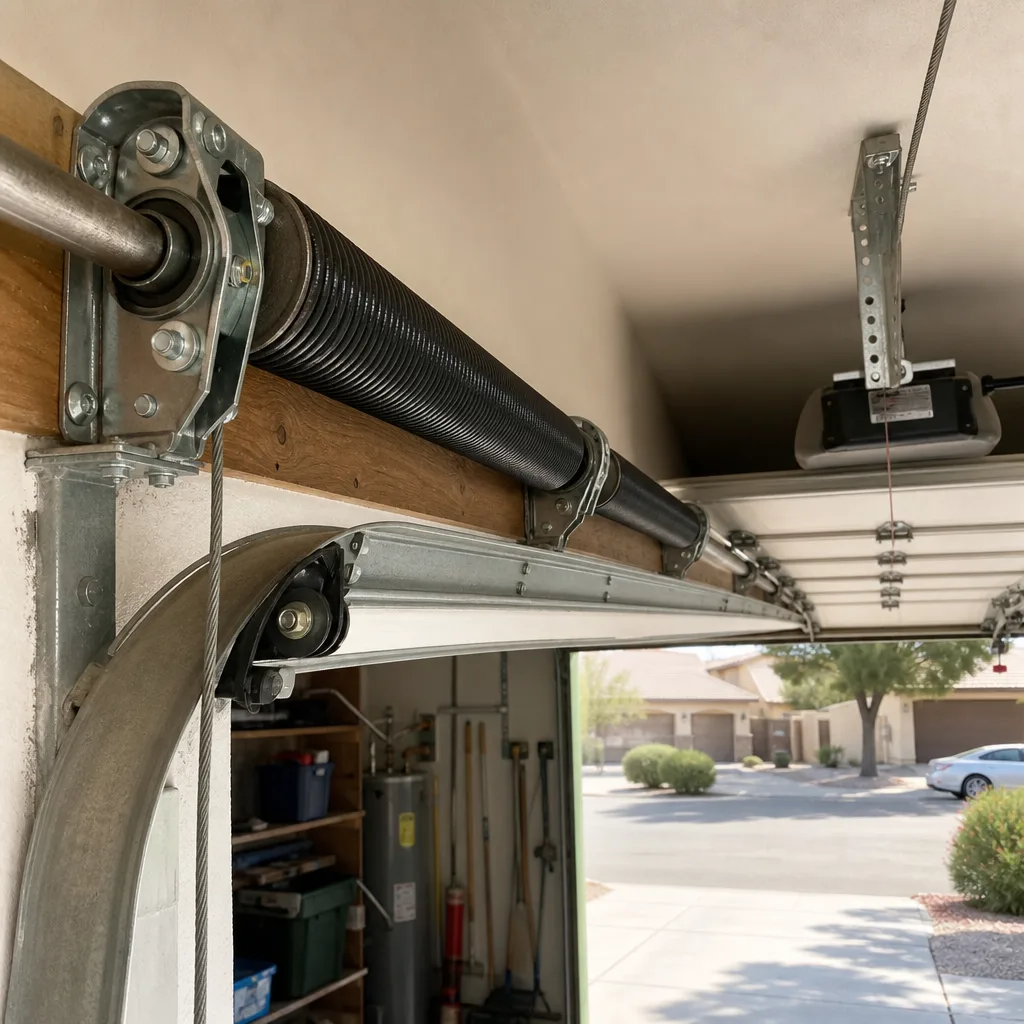 After
After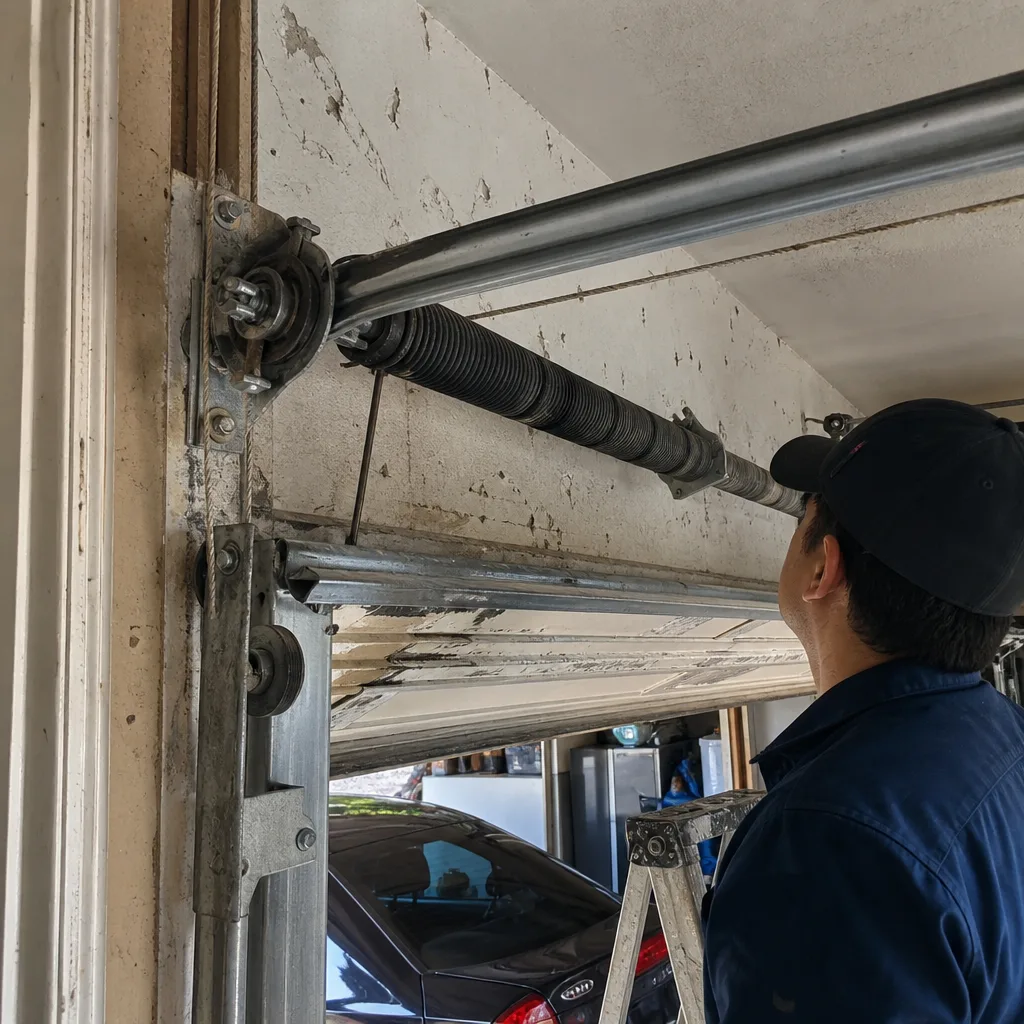 Before
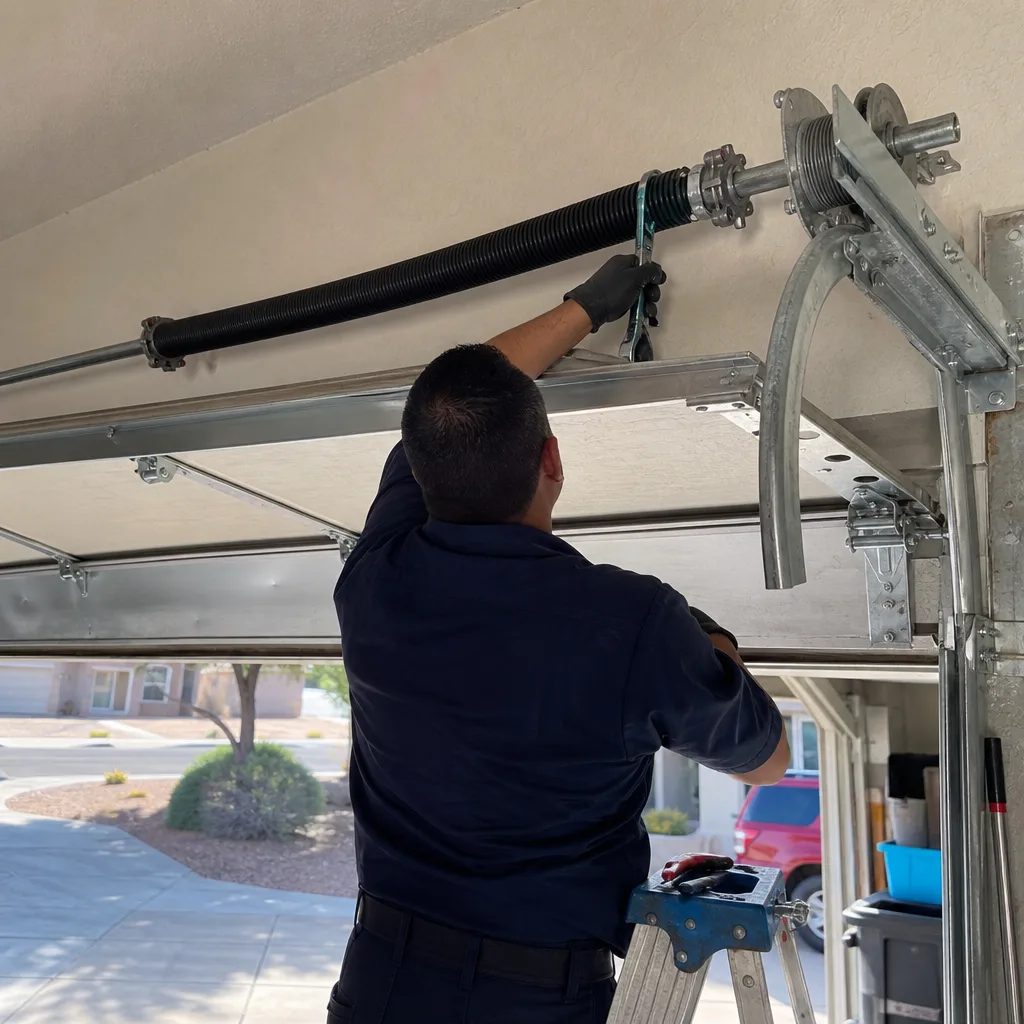 After
After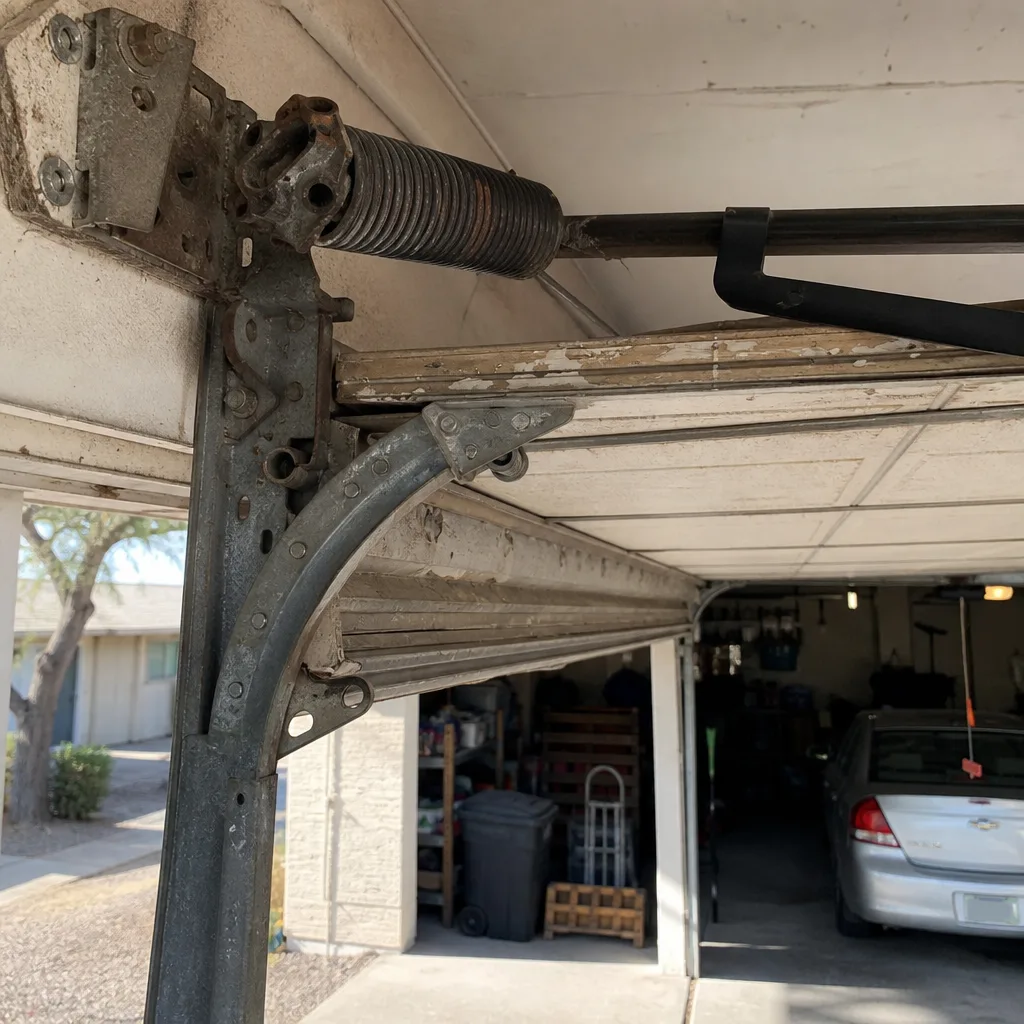 Before
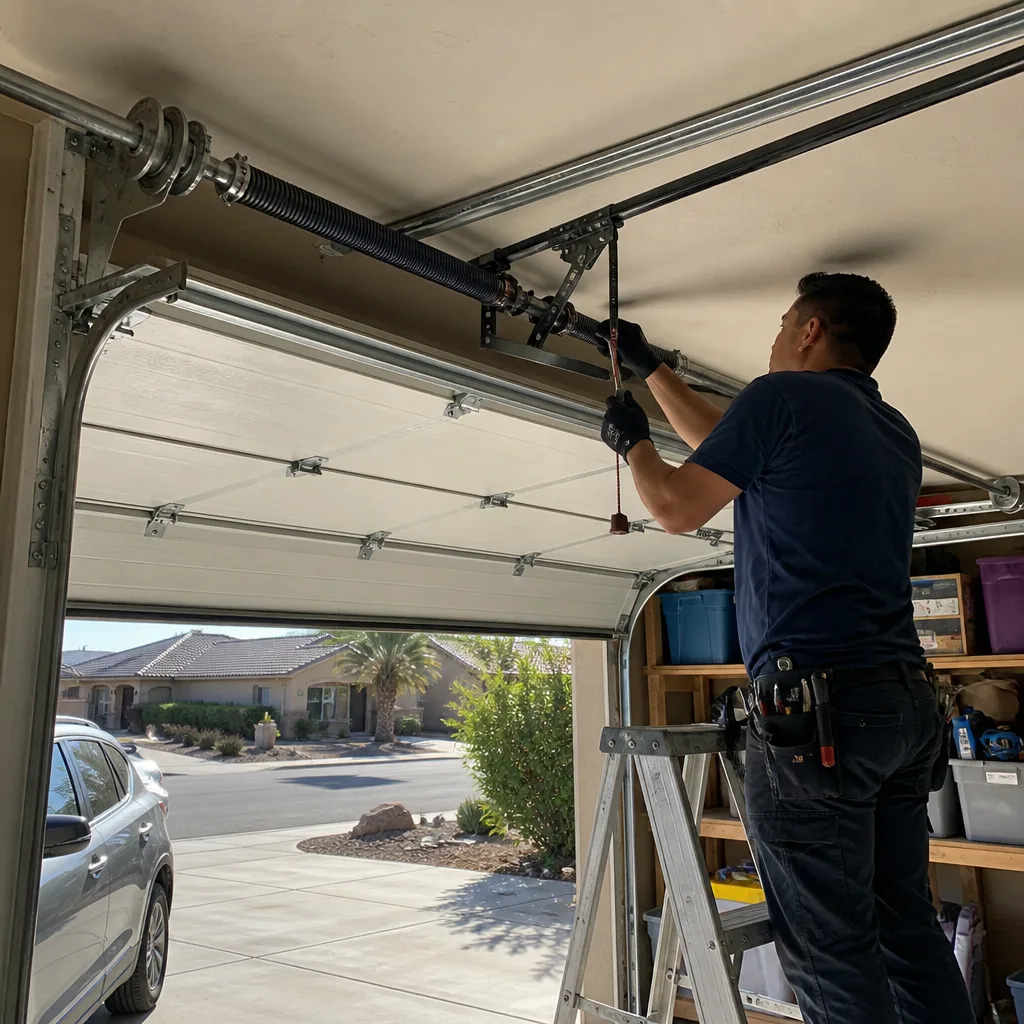 After
AfterThe Complete Guide to Garage Door in Mesa
The national average garage door lifespan gets cited as 15 to 30 years, but that range was not built on Arizona data. A steel door painted dark brown and facing west in Mesa can shed a decade of that estimate before the first spring breaks. This guide maps the variables a Mesa homeowner actually controls: spring cycle ratings calibrated to desert temperature swings, panel materials that survive 115°F afternoons, HOA submission paperwork, and the caliche soil that quietly shifts your track alignment. We’ve written it from the ground up for Mesa specifically, and you can find more guides & resources tailored to Arizona homeowners.
Quick Answer
A garage door in Mesa is a system you can engineer for the climate: choose a torsion spring with a cycle rating of at least 25,000, a panel material rated for high-heat UV exposure, and a track assembly adjusted for caliche-related settling. For a detailed look at these numbers, see our Garage Door Cost Breakdown: The Mesa Homeowner’s Reference for 2026; expect to pay $850 to $2,400 for a quality door installed, $180 to $380 for spring replacement, and $220 to $500 for opener replacement, all with written pricing before work starts. The single highest-leverage decision is spring cycle rating, not door brand or panel style.
Table of Contents
- How Mesa’s Climate Changes Garage Door Engineering
- Spring Cycle Ratings: Why Mesa Needs More Than the Catalog Says
- Panel Materials That Survive Mesa’s 50°F to 115°F Range
- HOA Color and Style Submissions in Mesa Communities
- Caliche Soil, Foundation Settling, and Track Alignment
- How to Read a Mesa Permit History on Your Home
- What Garage Door Work Actually Costs in Mesa
- A Maintenance Schedule That Works for the Desert
BeforeAfterHow Mesa’s Climate Changes Garage Door Engineering
Mesa’s annual temperature swing runs from near-freezing winter nights to sustained stretches above 110°F. That range is the controlling variable for almost every component decision you’ll make. Steel expands and contracts. Grease thins and migrates. Nylon rollers embrittle faster under sustained UV. The door that works flawlessly in a Phoenix garage kept at 80°F behaves differently when the garage itself sits at 105°F for four months straight.
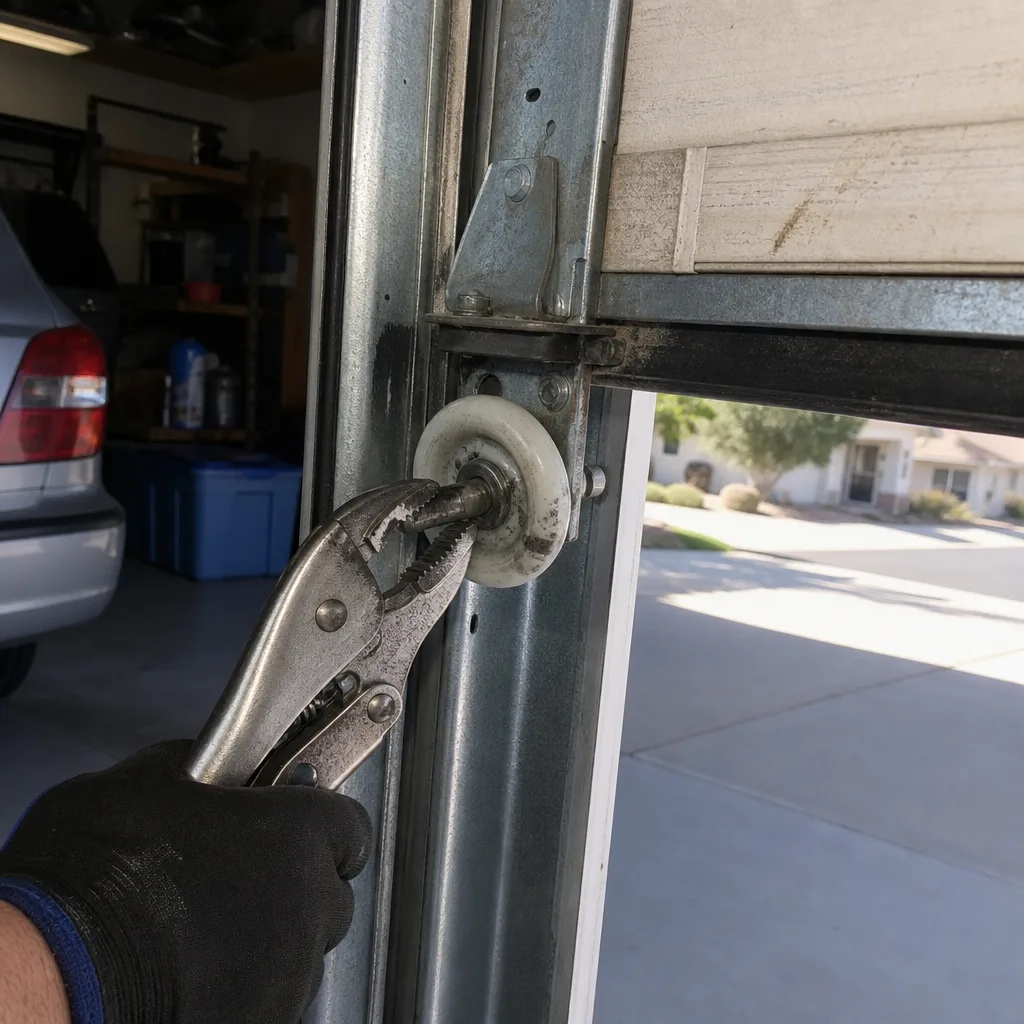
We see this in specific, repeatable ways. Torsion springs lose measurable tension faster in Mesa than in coastal climates because the metal cycles through wider thermal expansion daily. Garage door opener logic boards fail more often in unconditioned Mesa garages than in basements up north, and it’s not a defect, it’s a thermal environment. The heat also dries out the nylon bushing inside the track rollers, which is why a roller that spins freely in January can seize in July.
What this means for a homeowner: treat the Mesa climate as a load condition, not a footnote. When you compare products, ask what temperature range the manufacturer rates for continuous exposure. A door rated for “normal residential use” but installed west-facing in a Mesa summer is operating outside its design envelope before you ever press the opener button. The good news is that the fixes are known and priced: heavier-duty rollers, high-cycle springs, and operators with thermal protection. None of these are exotic. You just have to ask for them by name.
Spring Cycle Ratings: Why Mesa Needs More Than the Catalog Says
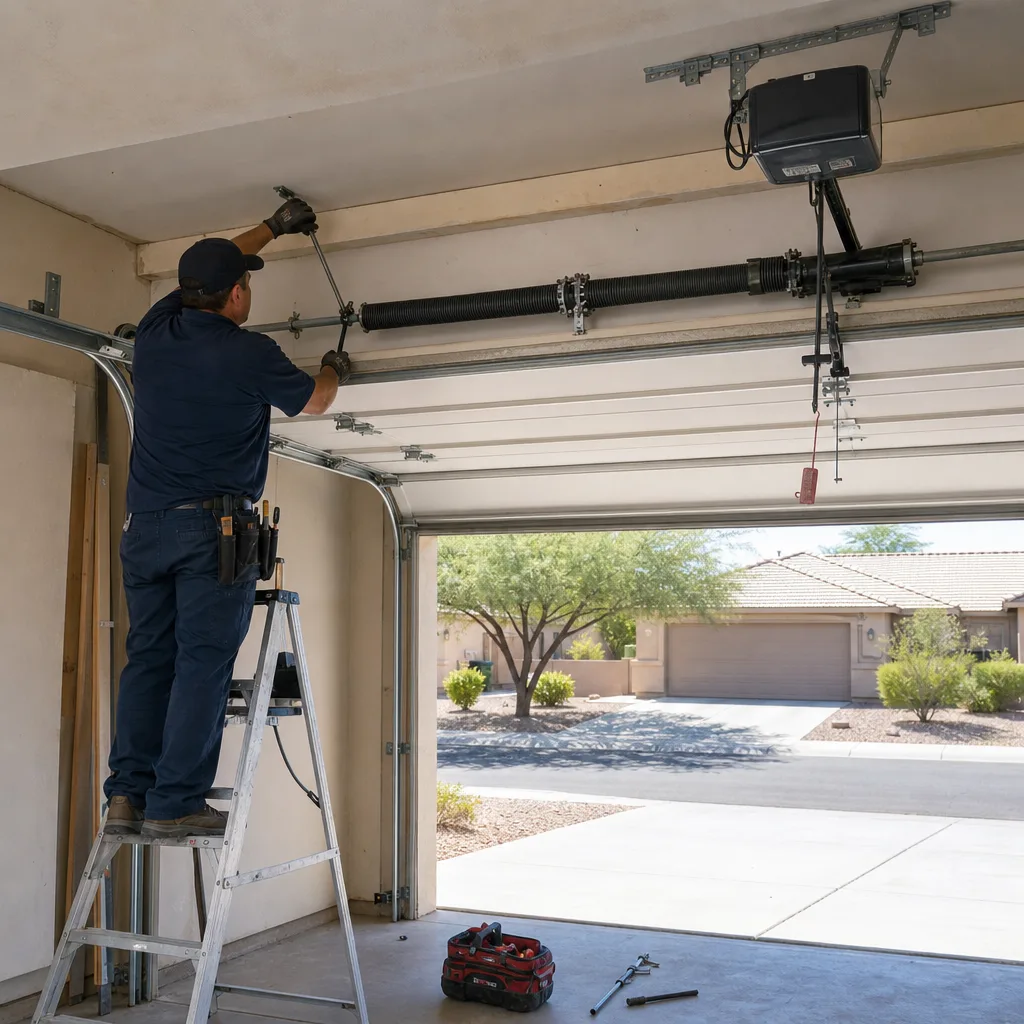
Most residential torsion springs sold nationally are rated for 10,000 cycles. A cycle is one full open-and-close of the door. The industry’s standard math says a 10,000-cycle spring lasts about seven to ten years for a door used four times a day. In Mesa, we see 10,000-cycle springs fail closer to the five to seven year mark, and the reason is temperature: higher ambient heat accelerates the metal fatigue curve that every spring lives on.
Here’s how to think about it. A spring rated for 10,000 cycles exercised four times a day should last about 2,500 days. But that rating assumes a stable temperature environment. The thermal cycling Mesa puts a spring through, expanding and contracting every single day through the summer, adds stress the rating doesn’t account for. We’ve measured failed springs in Mesa that broke at the coil cleanly, the classic fatigue fracture, at a fraction of their rated cycles.
The practical guidance: when you replace springs in Mesa, specify a minimum 25,000-cycle rating. The upcharge over a 10,000-cycle spring is modest, often $40 to $80 per spring, and it roughly doubles your service life in this climate. If you operate the door more than six times a day, move to 40,000-cycle or better.
One more Mesa-specific note: spring replacement is the most common garage door repair we perform, and it’s the one place where cheaping out costs you the most over time. Our Garage Door Repair in Mesa guide covers spring failure in more depth, including what a broken spring looks and sounds like when it lets go.
How to Check Your Spring Cycle Rating
- Look at the painted color on the end of the torsion spring cone, the metal piece at one end. Standard 10,000-cycle springs are often painted black or left unpainted; high-cycle springs use color codes like green, gold, or blue depending on the manufacturer.
- Read the wire diameter with a caliper if you have one. Most standard residential springs are 0.225 to 0.250 inch wire. High-cycle springs run thicker, often 0.262 to 0.295 inch, because more wire means more material to fatigue over time.
- Ask whoever installed or last worked on the door for the spring spec. A reputable installer will have it on the work order. If they can’t tell you the cycle rating, that’s a sign the replacement was done to whatever was cheapest.
Panel Materials That Survive Mesa’s 50°F to 115°F Range
Door panel material is where Mesa homeowners make the most expensive mistakes. The three common options are steel, aluminum, and fiberglass composite, and each behaves differently when the west-facing afternoon sun hits 160°F on the panel surface. Let’s go through them honestly.
Steel is the default choice for a reason: it’s the stiffest and most dent-resistant option. But steel gauge matters more in Mesa than anywhere else. A 27-gauge steel panel, the economy standard, absorbs heat and can oil-can or ripple when the temperature differential hits its peak. A 24-gauge panel is measurably more stable. If you’re buying a steel door in Mesa, don’t go thinner than 25-gauge, and avoid dark colors on west-facing exposures unless the manufacturer specifically rates the paint for high solar reflectance. Clopay and Amarr both make desert-rated steel lines with polyurethane insulation that doubles as a heat barrier, not just a noise barrier.
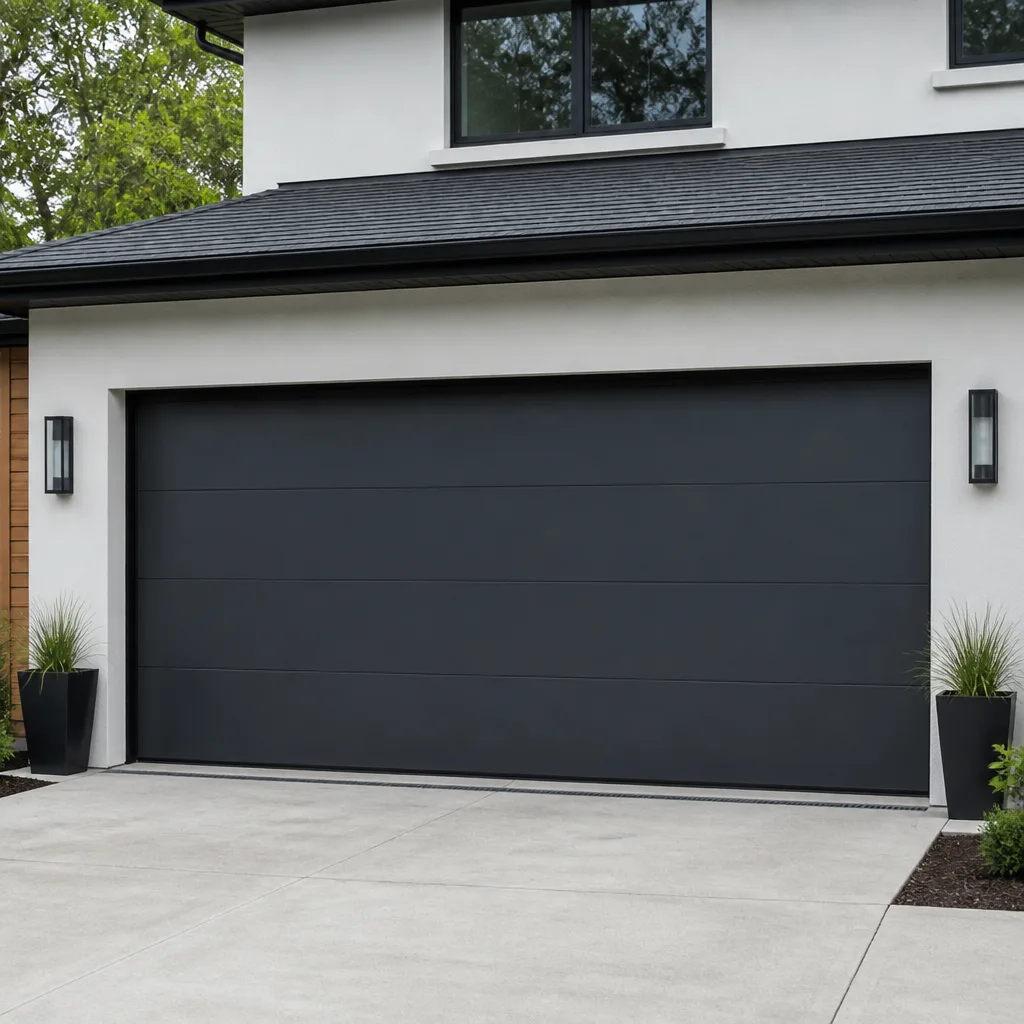
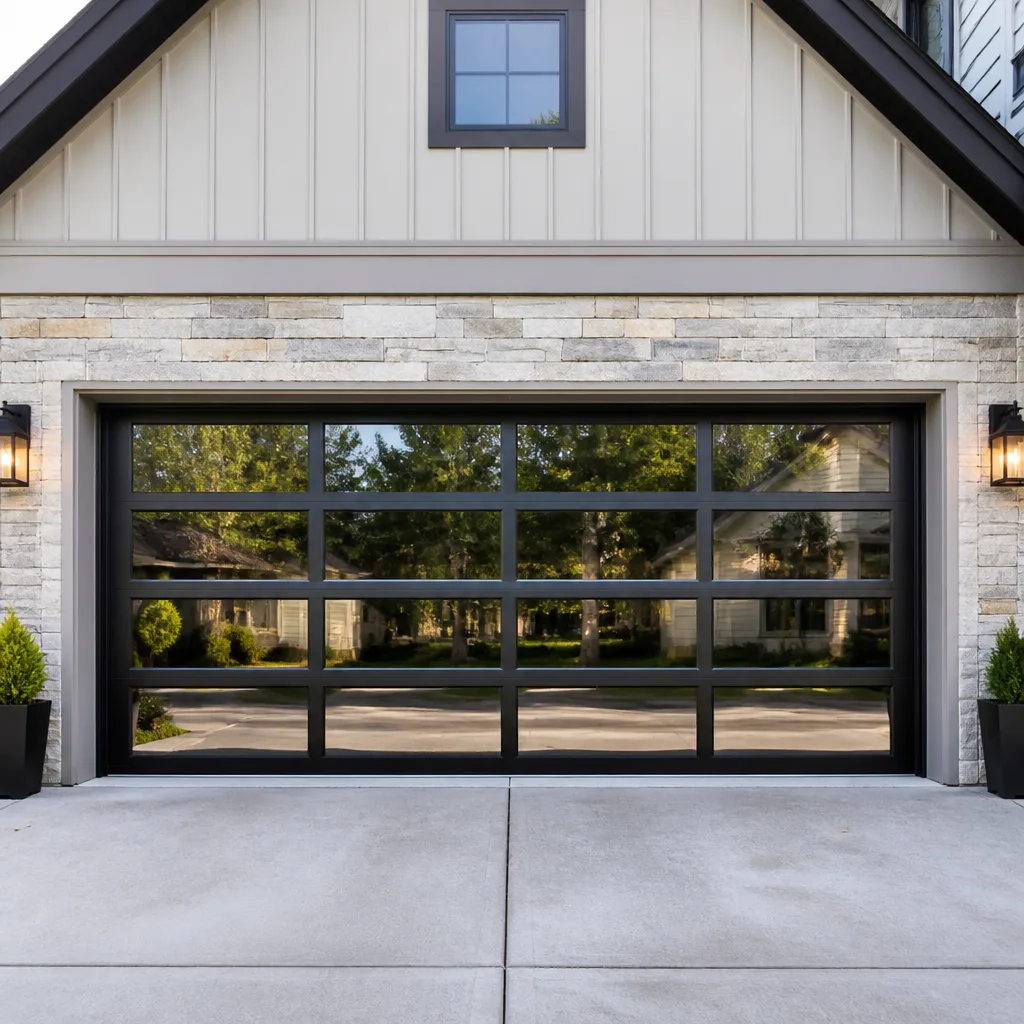
Aluminum is lighter and resists corrosion, which matters in Mesa less for rain and more for the alkaline dust that settles on everything. The tradeoff is dent resistance; a full aluminum panel door will show impact from a basketball or a stray ladder more readily than steel. Aluminum works well for contemporary full-view doors with glass inserts, which is the style Mesa HOAs increasingly approve for modern architecture.
Fiberglass composite is the underrated option for Mesa. It doesn’t conduct heat as aggressively as metal, it doesn’t warp under sustained UV, and it’s light enough to reduce strain on springs and openers over the life of the door. The downside is cost and availability; fewer brands offer full composite residential lines, and you’ll pay 20% to 40% more than an equivalent steel door. But for a west-facing garage door in Mesa, composite is often the only material that looks the same in year eight as it did in year one.
HOA Color and Style Submissions in Mesa Communities
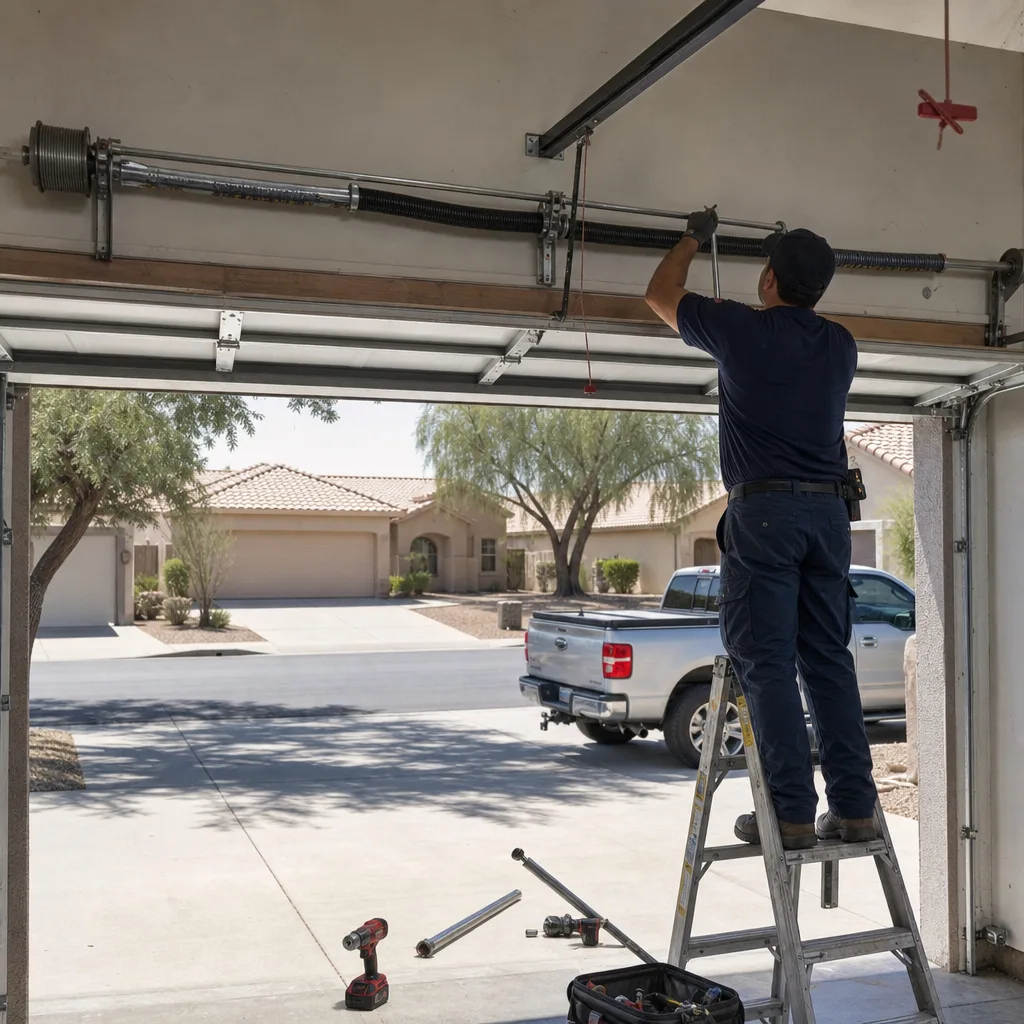
Mesa has more than 400 HOA-governed communities, and most of them treat the garage door as part of the architectural review process. That means you can’t simply pick a door and schedule installation; you have to submit the style, color, material, and sometimes the manufacturer spec sheet to a design review committee before any work happens. Skip this and you’ll get a compliance letter, which in most Mesa HOAs carries the power of a lien if ignored.
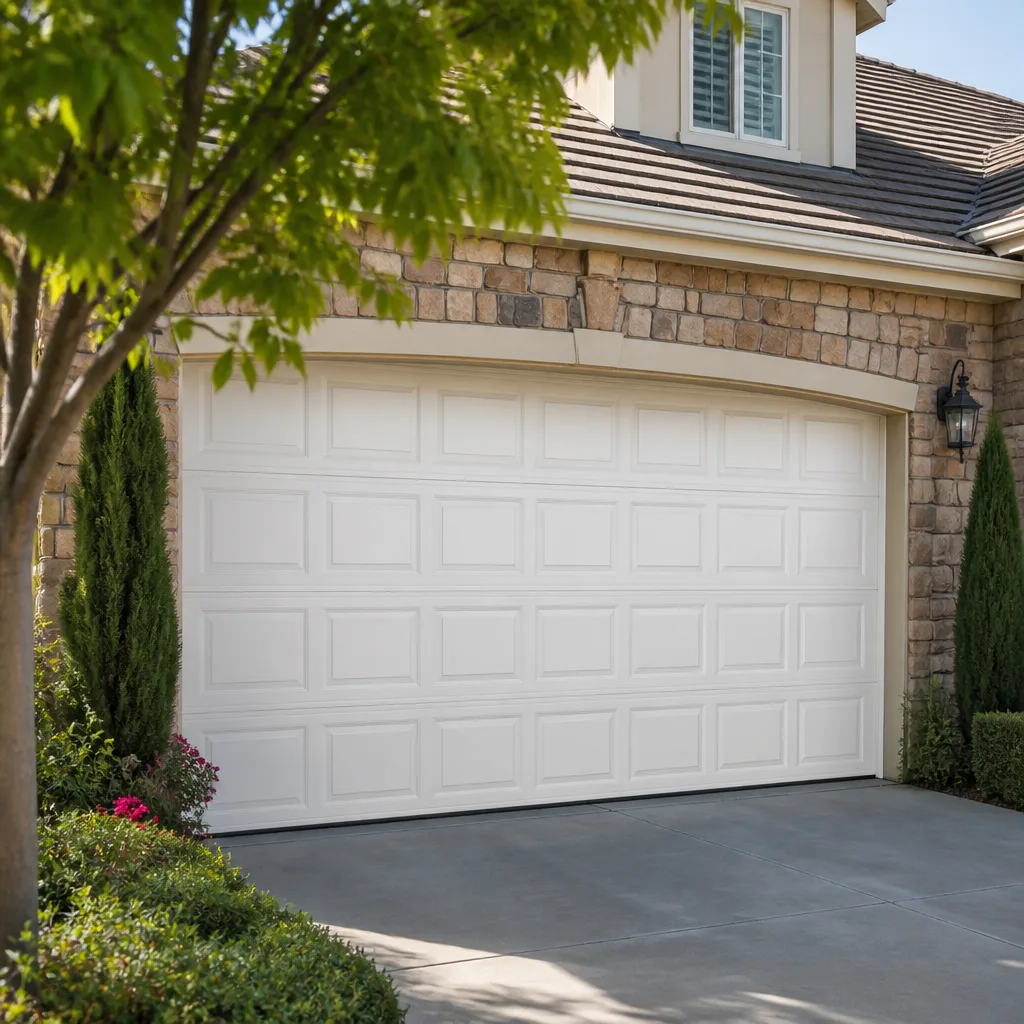
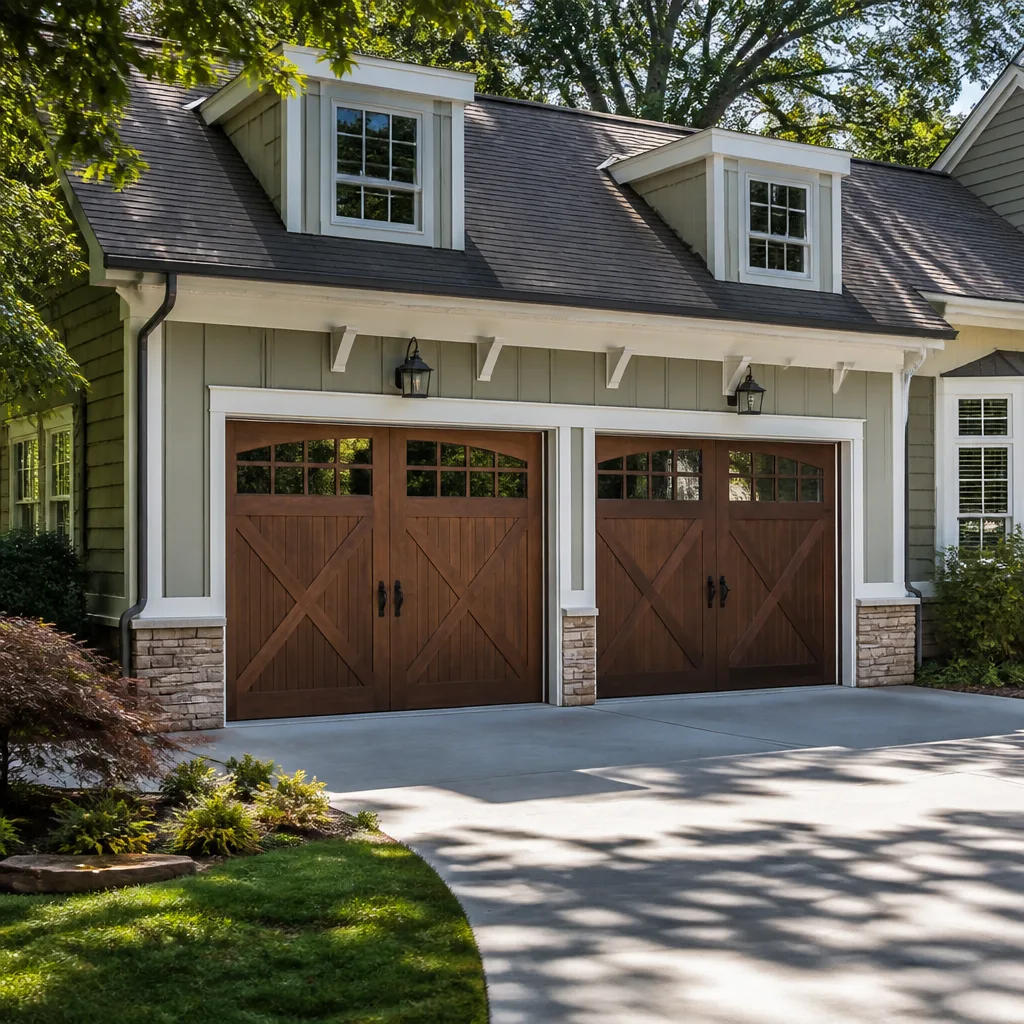
The process varies by community, but here’s the general shape. In Eastmark, the design guidelines require a submittal through the community portal with the door’s color name and manufacturer listed, and the review window is typically 10 to 14 days. Dobson Ranch, one of Mesa’s older planned communities, has a stricter palette and asks for a physical color sample or a manufacturer swatch card. Las Sendas enforces a style guide that favors specific panel profiles, often raised-panel or carriage-house designs, and will reject flat modern doors that other Mesa neighborhoods approve without comment.
The documentation an HOA request typically needs: manufacturer name, model number, color name, material, insulation R-value if applicable, and a photo or rendering of the door style. If your installer can’t produce a manufacturer spec sheet on request, that’s a signal they haven’t done this work in Mesa HOA territory before. We provide the spec sheet as part of the written scope on every installation, because we’ve seen too many homeowners get a door installed and then get a letter demanding it be changed.
Caliche Soil, Foundation Settling, and Track Alignment
Mesa sits on caliche, a calcium-carbonate-hardened soil layer that forms naturally in the desert. Caliche doesn’t expand and contract the way clay soil does in other states, but it also doesn’t drain the same way, and over decades it settles unevenly as the softer soil above compacts. For a garage door, that settlement shows up as a door that slowly goes out of square: the gap at the bottom grows on one side, the rollers start to bind, and the door begins to make a grinding sound that wasn’t there before.
This is a Mesa-specific rhythm. In neighborhoods built on the old agricultural land south of Baseline Road, the settling tends to be more pronounced than in the newer subdivisions on the northeast side of the 202. Homes in the Lehi neighborhood and parts of central Mesa show it more. We’ve worked on doors where the header above the opening had dropped a quarter inch on one side over fifteen years, enough to pull the tracks out of parallel.
The fix is not a new door. The fix is a track realignment, plus a bottom seal replacement if the gap has been letting dust and hot air in. A bottom seal in Mesa also takes a beating from the dry heat; rubber dries and cracks, and the seal costs very little to replace but makes a measurable difference in how much dust and 110°F air gets into the garage. If the settling is significant, the concrete below the door opening may need leveling, which is a project for a concrete contractor, but the door side of the equation is straightforward track work.
How to Read a Mesa Permit History on Your Home
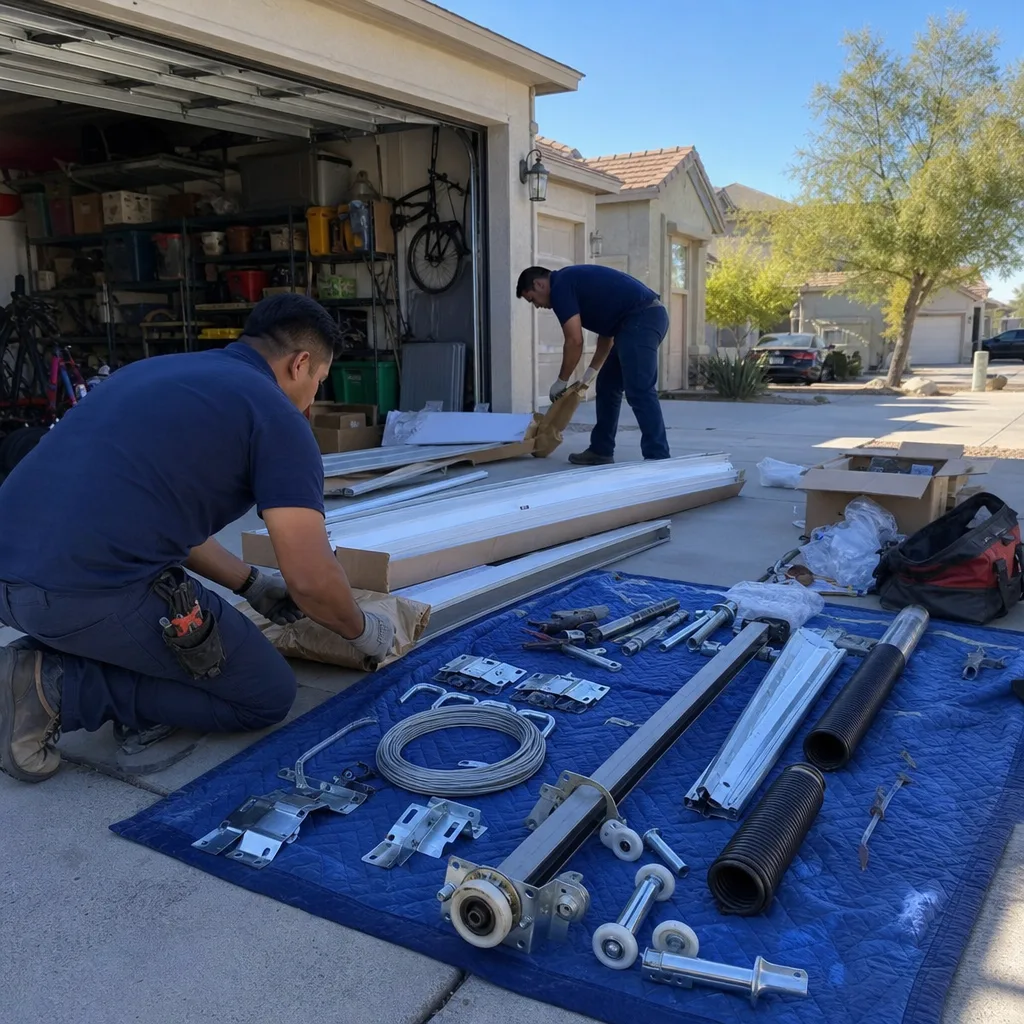
If you bought a home in Mesa between 2015 and 2025, there’s a decent chance the garage door on the house is not the one that was installed when the home was built. Checking whether a previous owner pulled a permit for a door replacement is one of the smartest things you can do before you spend money on repairs, because an uninspected installation often hides problems that aren’t visible from the interior. Our guide to Garage Door Permits, Codes & Inspections in AZ: What You Need to Know explains how to verify this.
Mesa requires a permit for garage door replacement when the new door involves structural changes or when the opener is replaced with a unit that requires new wiring. The city’s permit records are public, and you can look them up online through the Mesa city permit portal. Here’s the step-by-step:
- Go to the City of Mesa’s building permit search page and enter your street address.
- Look for any permits with a description containing “garage door” or “overhead door” or “residential remodel” with a garage scope.
- Note the permit date and the contractor name listed. If the permit was pulled by a company that no longer exists, that’s useful information but not disqualifying.
- If you find no permit and the door clearly isn’t original, call the city’s building division and ask whether the specific scope of work on your home would have required one. Some door swaps don’t, and the city staff will tell you.
- If you’re buying a home, have your inspector specifically check the spring, the track mounting, and the opener wiring against current Mesa code before you close.
An unpermitted previous installation doesn’t automatically mean the door is unsafe. But it does mean nobody verified the mounting hardware, the spring system, or the opener wiring. In our experience, unpermitted work in Mesa tends to cluster around the same shortcuts: undersized springs, missing safety cables, and openers wired without a dedicated circuit.
What Garage Door Work Actually Costs in Mesa
Every guide should give you numbers, not vague “call for pricing.” Here are the realistic ranges we see in Mesa in 2025, based on the homes and doors we’ve worked on across the city. These are installed prices for a typical two-car garage door, and they assume a licensed contractor doing the work with a written scope.
- Spring replacement (single spring): $180 to $380. The range is driven by spring cycle rating; a 25,000-cycle spring costs more than a 10,000-cycle spring, and in Mesa we recommend the higher rating.
- Full spring system replacement (both springs on a two-car door): $350 to $650. Replacing both springs at once is standard practice, because they wear at the same rate.
- Opener replacement (motor unit, installed): $220 to $500 for a belt-drive unit from Chamberlain or Genie, including labor and basic rail and safety sensor setup.
- Complete garage door replacement (steel, insulated, standard panel style): $850 to $1,800 installed, depending on gauge, insulation R-value, and the amount of trim and hardware replacement needed.
- Complete door replacement with HOA-mandated style or custom color: $1,500 to $2,400 or more, with the premium driven by door line (Clopay, Amarr) and the specificity of the HOA’s approved palette.
- Track realignment and roller replacement: $150 to $350, which is the most common non-spring maintenance job we do in Mesa due to caliche-related settling.
One thing we say plainly to every customer: the price quoted is the price we do the work at. No number changes after we see the job, because we write the scope after inspecting, not before. That’s Clause 1 of The Haven Standard, the documentation system we operate under, and it means the written price and the written scope are in your hands before any tool comes out of the truck.
A Maintenance Schedule That Works for the Desert
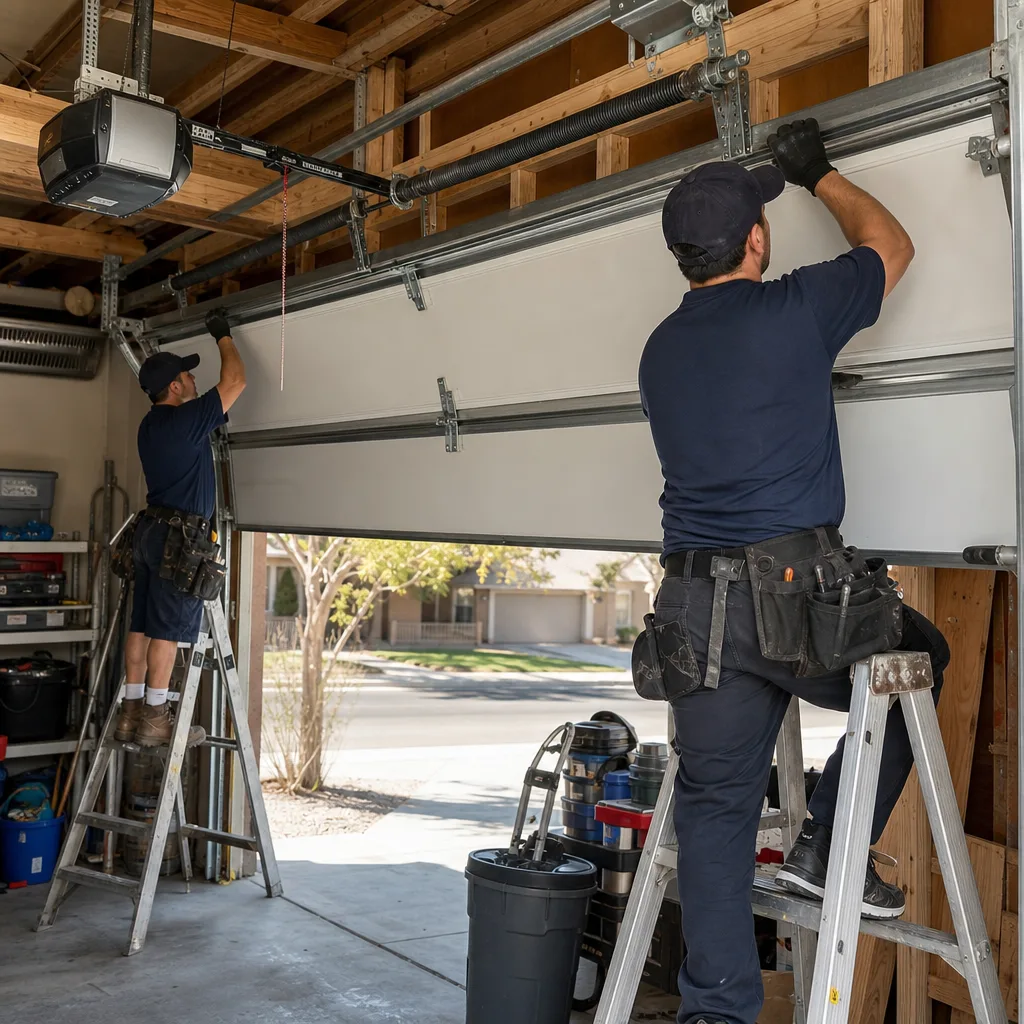
Garage door maintenance in Mesa is not a once-a-year checklist. The desert asks for specific things at specific times, and the schedule below is what we’d tell a neighbor to do. None of it requires special tools beyond a ladder, a rag, and about twenty minutes every quarter.
Quarterly (Every Three Months)
- Stand inside the closed garage and look at the bottom seal. If you can see daylight through any gap, the seal is shot and the door is leaking cooled air and letting dust and bugs in. Replace it. The seal costs under $30 and installs in under an hour.
- Run the door up and down twice while standing next to it, not across the room. Listen for metal-on-metal contact. A door in good tune should be quieter than the car engine you don’t hear anymore.
- Check the bracket where the opener arm attaches to the door. In Mesa’s dry heat, the fasteners here work loose faster than anywhere else we’ve seen.
Twice a Year (Spring and Fall)
- Clean the photo-electric safety sensors, the two small lenses near the floor on either side of the opening. Mesa dust coats them fast, and a coated sensor makes the door reverse for no reason.
- Wipe down the vertical tracks with a dry rag. Don’t lubricate the tracks, ever. Grease on the tracks collects dust and turns into paste.
- Apply a small amount of white lithium grease to the torsion spring. This is the one component that needs lubrication, and in Mesa’s dry air it needs it more often than the northern guides suggest.
Every Two to Three Years
- Have the spring tension checked with a torque meter. Springs lose tension gradually, and a spring that’s down 15% from spec makes the opener work harder and shortens the life of both components.
- Check the balance of the door by disconnecting the opener and lifting the door manually. It should stay put at about waist height. If it drops or climbs, the spring tension is wrong and the system is wearing unevenly.
One safety note that applies to all of this: the torsion spring is under constant tension. It stores enough energy to break a hand or worse if it lets go while you’re near it. We photograph and document spring work on every visit because the risk is real, and because Clause 4 of The Haven Standard requires the customer to see the failed part before we quote a replacement. If you’re anywhere near a spring that looks worn, call a professional. Don’t adjust it yourself-read our DIY vs Professional Garage Door: The Mesa Homeowner’s Decision Guide to understand why.
Common Mistakes to Avoid
- Buying a 10,000-cycle spring because it’s $50 cheaper. In Mesa, a standard-cycle spring fails years earlier than its rating suggests. The $50 you saved buys you a second service call and a second labor charge, and the math doesn’t work in your favor.
- Choosing a dark west-facing steel door without checking the paint’s solar reflectance. Dark doors on west exposures in Mesa can reach surface temperatures over 160°F in summer. That heat transmits into the garage and accelerates every component’s wear. If you want a dark door, ask for a solar-reflective paint formula.
- Skipping the HOA submittal because the installer said it’s fine. Installers don’t get the compliance letter. You do. In Mesa, a garage door that violates a community’s design guidelines can trigger a fine structure that accrues monthly until the door is replaced.
- Lubricating the tracks. Grease on the track rails attracts desert dust and turns into an abrasive slurry that wears out rollers. Keep the tracks dry and clean. The only component that gets lubricant is the torsion spring, and even that is a sparing amount.
- Replacing the door when the problem is the track. A door that binds, scrubs, or grinds as it opens is often a track alignment issue from caliche settling, not a door issue. Inspect the tracks before spending $1,500 on new panels.
- Trusting a verbal quote. A garage door job quoted over the phone without an inspection will change when the technician arrives. Get a written price and a written scope before work starts, every time, no exceptions.
- Ignoring the permit history when buying a Mesa home. An unpermitted garage door installation can hide structural or electrical shortcuts that you inherit. A ten-minute permit search on the city portal tells you what you’re buying.
When to Call a Professional
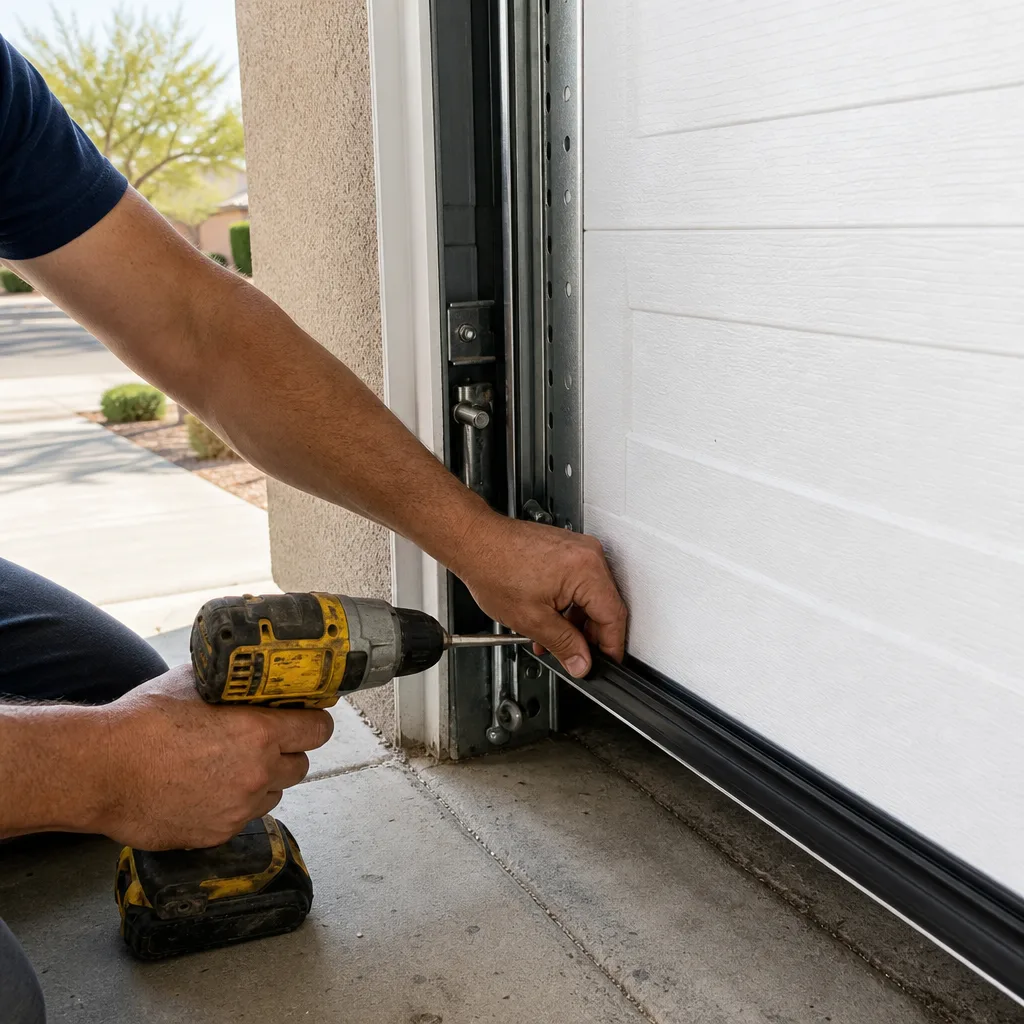
Call a professional when the torsion spring is involved, when the track has come away from the framing, when the opener’s electrical behavior is inconsistent, or when the door is heavy enough that you can’t lift it with one hand from the inside handle. These are not adjustments, they’re repairs with real risk. A spring under tension stores more than enough energy to cause serious injury if it releases, and a door that falls off its tracks can do structural damage to the garage and the car inside it. Servo Garage Doors Mesa offers free estimates across Mesa, and the pricing is always given as a written number before any work begins. Call (520) 391-9660 and we’ll send a technician who will document what they find, write the scope, and give you the price before touching a bolt.
Frequently Asked Questions
A standard 10,000-cycle torsion spring in Mesa typically lasts five to seven years with normal use, which is shorter than the seven-to-ten-year lifespan the same spring would achieve in a milder climate because the sustained heat accelerates metal fatigue. Upgrading to a 25,000-cycle spring extends that to roughly twelve to fifteen years in Mesa conditions. Call (520) 391-9660 for an exact spring rating recommendation based on your door, it’s part of every free estimate we do.
A steel door with a minimum 24-gauge panel and a polyurethane insulation core performs best for most Mesa homes because it resists heat transfer and holds its shape through the 50°F to 115°F annual range. If the door faces west and gets direct afternoon sun, a fiberglass composite door is worth the premium because it doesn’t warp or fade the way darker steel panels do over time. We can show you the spec differences in person during a free consultation.
In most Mesa communities, yes, you need architectural review approval before replacing a garage door, and the submittal typically requires the manufacturer name, model, color name, and material spec. Communities like Eastmark, Dobson Ranch, and Las Sendas all enforce this through their design review process, and failing to submit can result in monthly fines. Bring us your HOA’s design guidelines and we’ll prepare the submittal package as part of the installation scope.
A single torsion spring replacement in Mesa runs $180 to $380, with the higher end reflecting high-cycle springs rated for 25,000 cycles or more. Replacing both springs on a two-car door typically runs $350 to $650. Every quote we give is a flat written price delivered before any work starts, per Clause 1 of The Haven Standard. Call (520) 391-9660 and we’ll give you the number after a documented inspection, not before we’ve seen the door.
A grinding sound in a Mesa garage door is most often the result of track misalignment from caliche-related foundation settling, which is common across the city but especially in older neighborhoods south of Baseline Road. The second most common cause is a roller with a dried nylon bearing, which fails faster here because the desert heat accelerates the breakdown. A track inspection is a $150 to $350 job that’s far cheaper than replacing a door that doesn’t need replacing.
Repair work like spring replacement or roller replacement can often be done same-day in Mesa because those jobs use parts that technicians carry on the truck. A new door or opener installation is a measured, ordered, and scheduled job, so we’ll come measure, give you a written price, and set a date that works around your HOA approval window if one is required. The price is always written and agreed before any work starts, and the quote doesn’t change once we’ve seen the job.
The Bottom Line
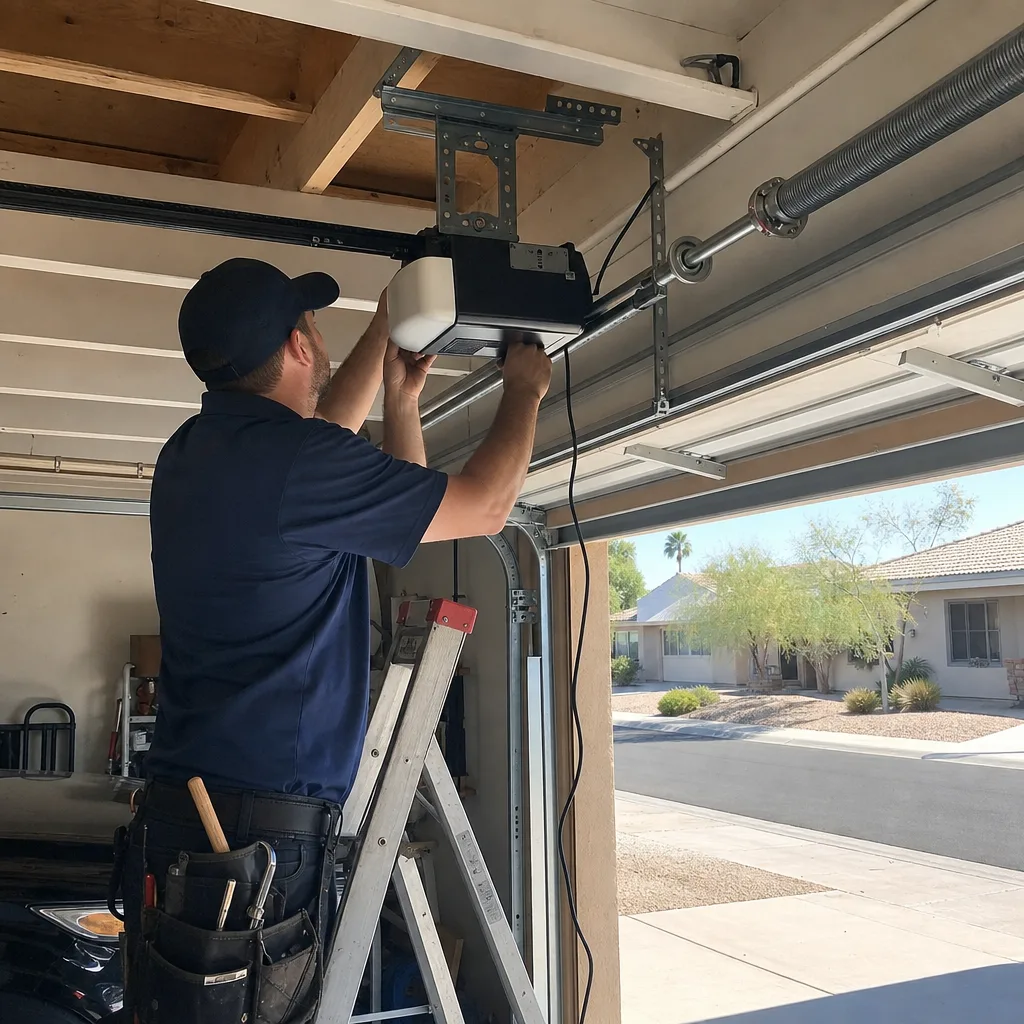
A garage door in Mesa is a system you can buy once and run for fifteen years, or a system you can nickle-and-dime yourself with. The decisions that matter happen before the work starts: spring cycle rating, panel material and color, HOA submittal, and track inspection. None of these are beyond a competent homeowner’s understanding, and all of them are documented, priced, and verified in writing when you work with a company that operates under The Haven Standard. Marcus Deller and the team at Servo Garage Doors Mesa home have been doing this work in Mesa since 2015, with a written price before any work starts and a photo record when the technician leaves. If you need a Garage Door Installation in Mesa or an Garage Door Opener Repair & Installation in Mesa, call (520) 391-9660 and get the number in writing before a single tool comes out of the truck.
Written by Marcus Deller, Owner at Servo Garage Doors Mesa, serving Mesa since 2015.