
Last updated September 20, 2026
Full 25-point door and opener safety check with every visit - springs, cables, rollers, tracks, and your LiftMaster or Chamberlain opener included
You get a price before we start. It does not change when the truck arrives.

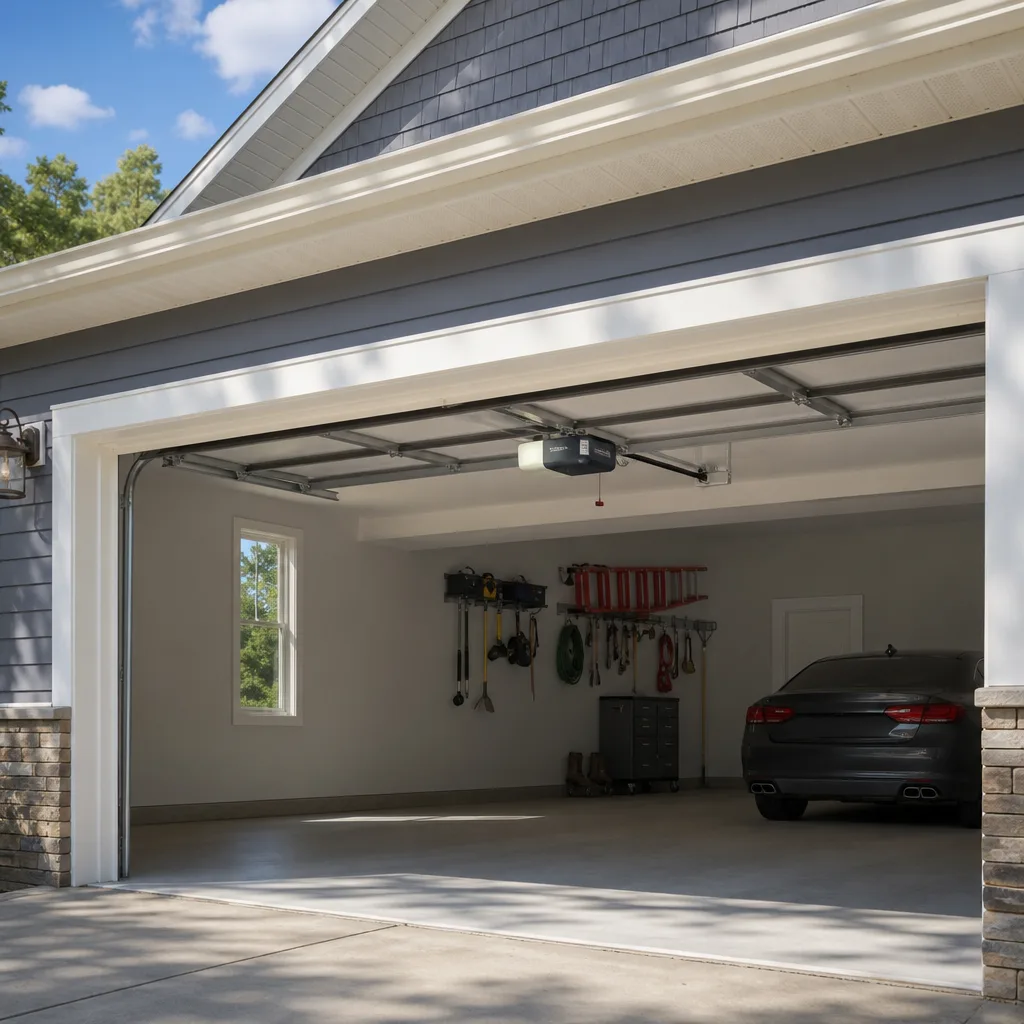
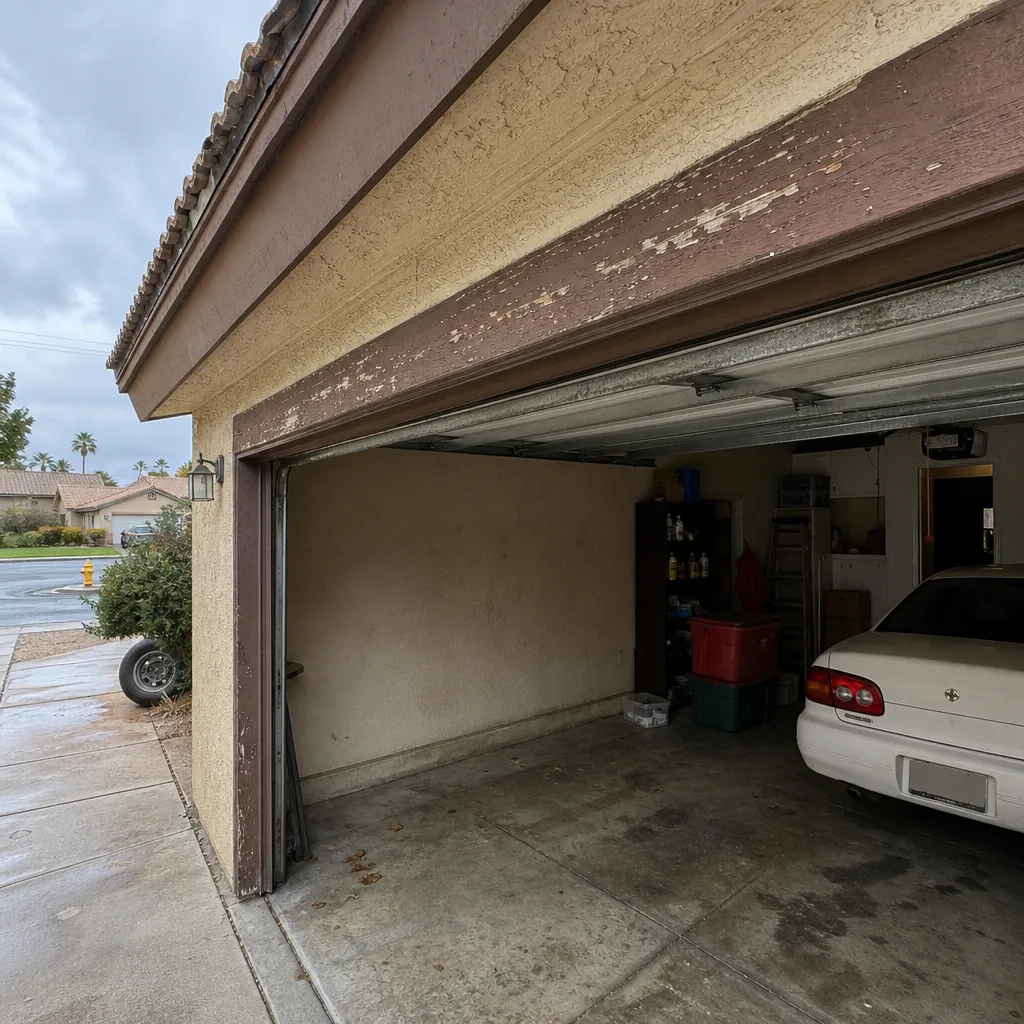 Before
 After
After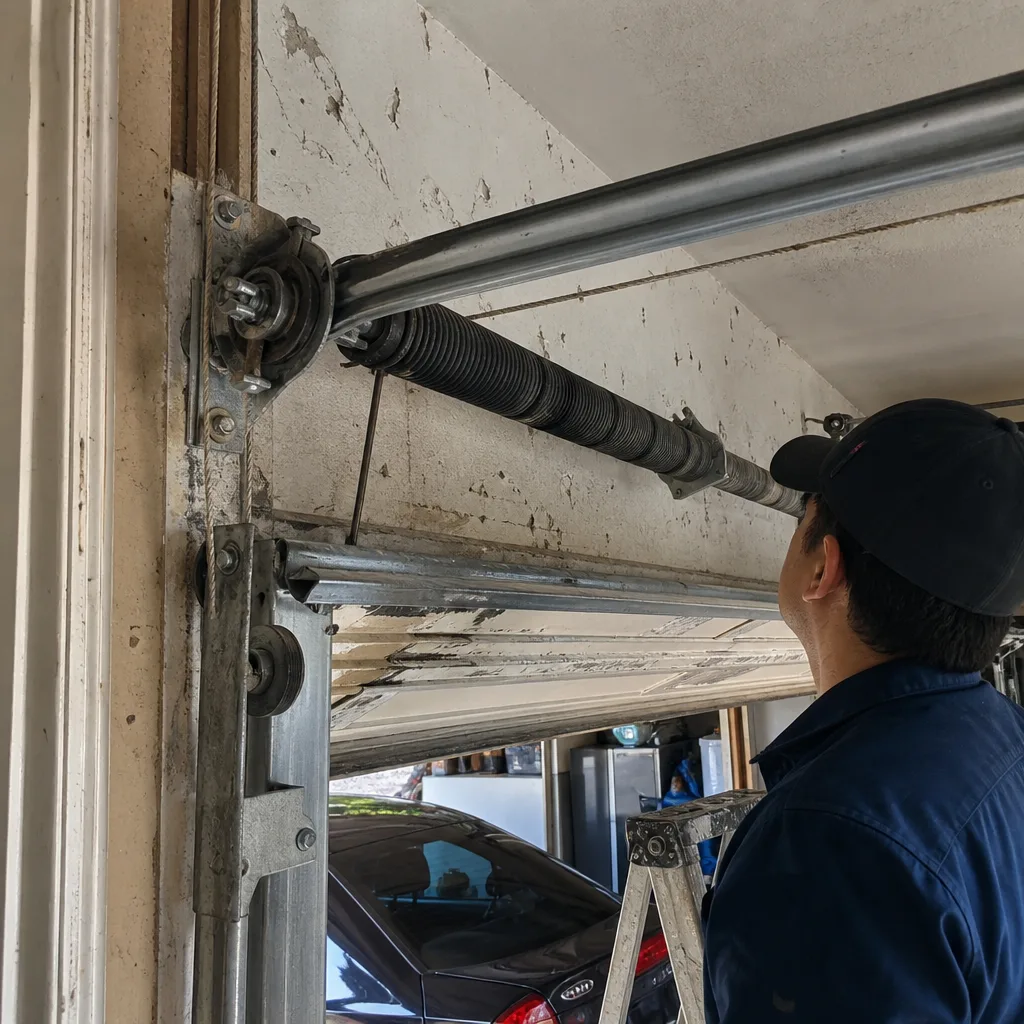 Before
 After
After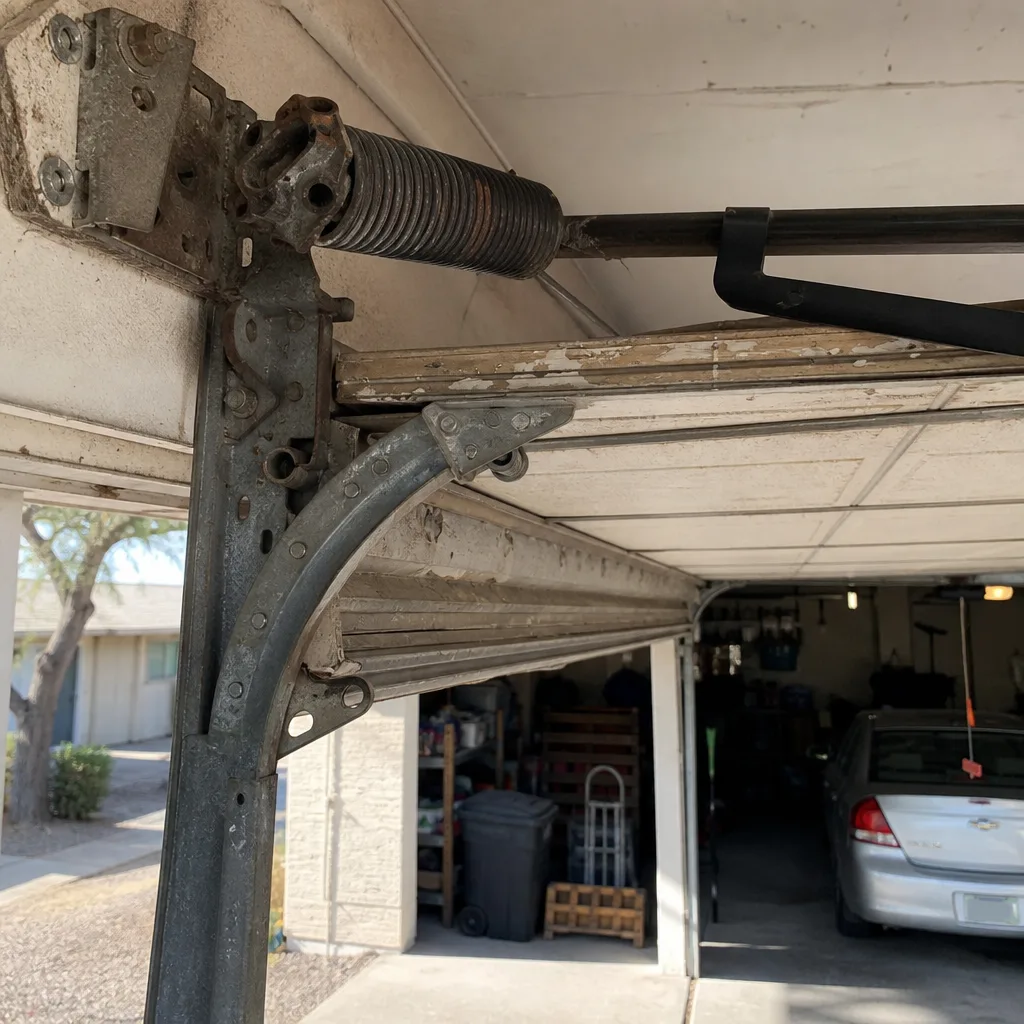 Before
 After
AfterSeasonal Garage Door Care for Mesa: Year-Round Homeowner’s Guide
Monsoon season in Mesa runs from July through mid-September, and it is the single highest-risk window for garage door bottom seal failure and track debris intrusion in the entire calendar year. Yet most seasonal maintenance guides treat August as just another summer month, recommending the same generic lubrication tips they’d give a homeowner in Ohio or Oregon. That’s a disservice to anyone living in the Sonoran Desert. This guide replaces the four-season template with a Mesa-accurate three-phase maintenance calendar built around the actual stress curves your garage door experiences here: a mild winter, a transitional spring, sustained extreme heat, and a violent monsoon window. For a deeper look at everything covered here, see The Complete Guide to Garage Door in Mesa. By the end, you’ll know exactly what to check, when to check it, and why the timing matters more than the checklist itself.
Quick Answer
Seasonal garage door maintenance in Mesa works best as a three-phase calendar, not a four-season one. Phase 1 (November-February) is your mild-weather window for lubrication, roller replacement, and opener force adjustment. Phase 2 (March-June) is when you inspect spring tension and cable condition before heat-driven metal expansion begins. Phase 3 (July-October) is monsoon prep and post-storm inspection: bottom seal integrity, weatherstripping adhesion, track fastener torque, and debris channel clearing. Most Mesa homeowners can complete Phases 1 and 3 themselves with basic tools; Phase 2 spring and cable work belongs in professional hands because torsion springs carry enough tension to cause serious injury. Not sure which route to take? Read our DIY vs Professional Garage Door: The Mesa Homeowner’s Decision Guide.
Table of Contents
- Why Mesa Needs Three Phases, Not Four Seasons
- Phase 1 (November-February): The Mild-Weather Service Window
- Phase 2 (March-June): Pre-Heat Stress Checks
- Phase 3 (July-October): Monsoon Prep and Post-Storm Recovery
- Mesa’s Urban Heat Island and Your Opener
- Component Replacement Scheduling: Buy Parts in February, Not August
- Common Mistakes to Avoid
- When to Call a Professional
BeforeAfterWhy Mesa Needs Three Phases, Not Four Seasons
Mesa doesn’t have four seasons in the conventional sense. We have three thermal regimes: a mild winter that runs roughly November through February, a transitional spring from March through June where temperatures climb steadily from the 70s into triple digits, and a sustained extreme heat period from late June through September that gets interrupted by the monsoon. Each regime stresses a different component of your garage door system, and the maintenance task that makes sense in one window is either unnecessary or actively difficult in another.
Here’s what most national seasonal guides get wrong: they assume winter is when garage doors need protection from cold and ice. In Mesa, our winter is the best working weather of the year. The real threat season is summer, specifically the monsoon, and the real maintenance window is the mild period when you can actually work on a door without sweating through your shirt or fighting metal that’s been baking at 140 degrees in direct sun. “Seasonal” maintenance in Mesa means aligning your work with temperature and weather events, not calendar months. That’s why the three-phase approach works better than any generic four-season checklist.
Phase 1 (November-February): The Mild-Weather Service Window
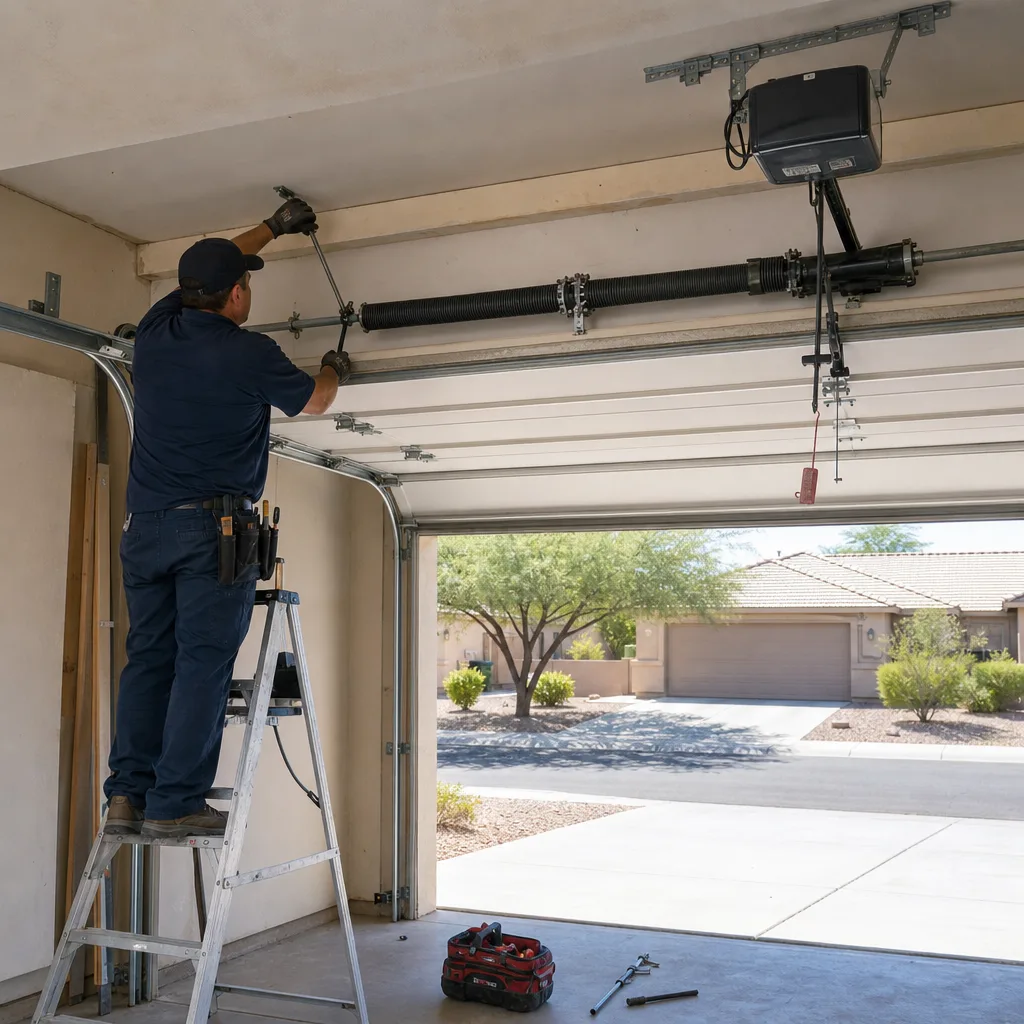
From November through February, daytime highs in Mesa typically sit between 65°F and 75°F. That temperature range is ideal for three maintenance tasks that become genuinely difficult to do accurately once ambient temperatures climb above 95°F: lubrication, roller replacement, and opener force adjustment.
Lubrication seems simple, but temperature matters more than most homeowners realize. A lithium-based garage door lubricant behaves differently at 70°F than it does at 105°F. In the mild window, the lubricant flows evenly into hinge pins, roller bearings, and spring coils without thinning out. During summer, the same lubricant can drip, run, or fail to stay where you put it. We’ve seen Mesa garages where the homeowner lubricated in July, and by August the tracks were dry again because the state had simply cooked off or dripped away.
Here’s the Phase 1 checklist we recommend, in order:
- Lubricate all moving parts: hinges, roller bearings (if they’re ball-bearing rollers), torsion spring coils, and the lock mechanism. Use a lithium spray or white lithium grease. Avoid WD-40 as a primary lubricant - it’s a solvent, not a long-term lubricant, and it strips the protective film off metal parts.
- Test the door balance: with the opener disconnected (pull the red emergency release cord), manually lift the door halfway. It should stay in place without drifting up or down. If it drops, your torsion spring is losing tension or is nearing the end of its service life.
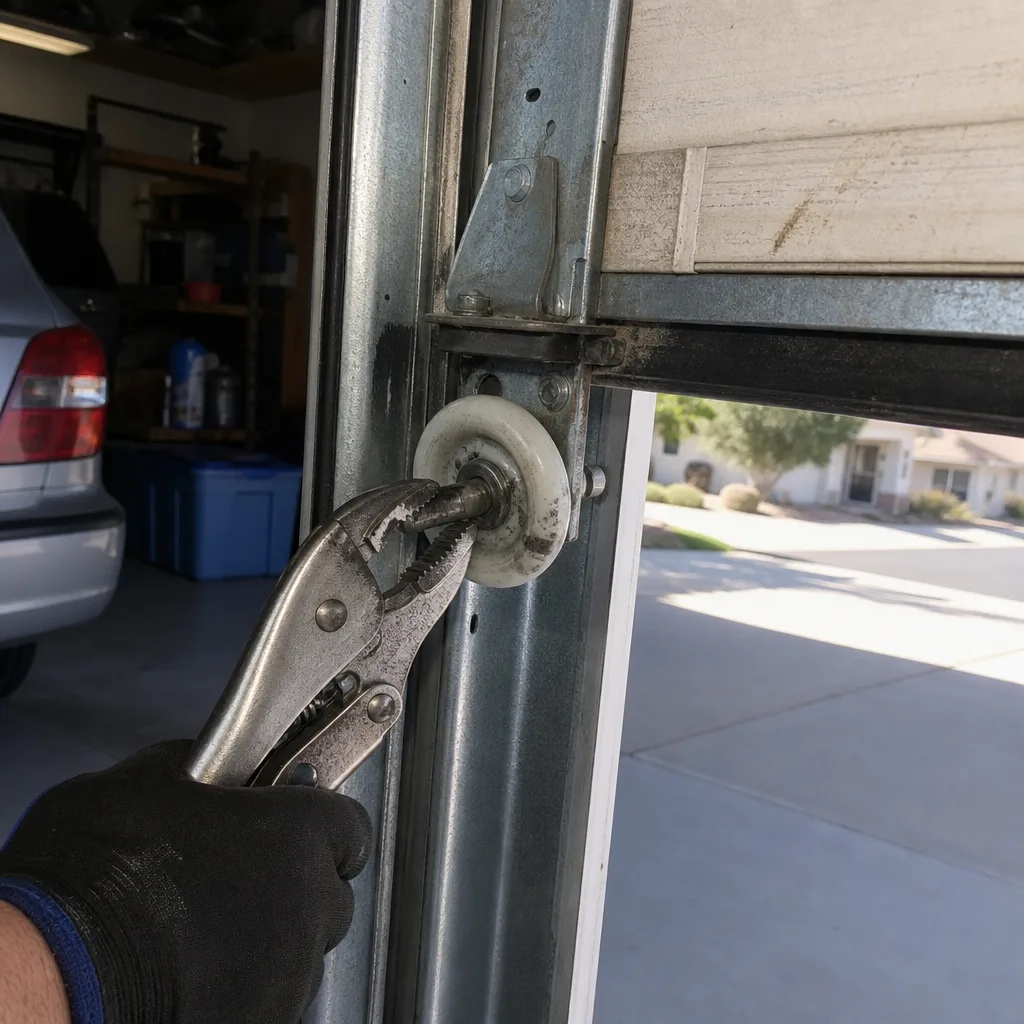
- Inspect rollers: nylon rollers with exposed bearings wear out after 7-10 years in Mesa’s dry, dusty conditions. Steel rollers with no bearings wear faster. If you see flat spots, cracks, or hear grinding when the door moves, replace the rollers before summer.
- Adjust opener force settings: your opener has up-force and down-force settings that tell the motor how hard to push or pull. In cool weather, settings can be calibrated more precisely because the door’s weight is stable. If your door has been reversing randomly or struggling, this is the window to correct it.
- Clean the photoelectric sensors: the two small units near the bottom of the door tracks collect dust and spider webs. A dry microfiber cloth and a gentle wipe is all it takes.
The reason we emphasize doing this work before March is simple: above 95°F, metal expands, lubricant behavior changes, and homeowners rush through maintenance because standing in a hot garage is unpleasant. The work done in the mild window simply holds up better.
Phase 2 (March-June): Pre-Heat Stress Checks
March through June in Mesa is a transition period where temperatures climb from comfortable into dangerous territory. By late May, ambient highs are routinely pushing 100°F, and your garage door’s metal components are beginning their annual expansion cycle. This is the window to inspect spring tension and cable condition before the heat-driven stress cycle really begins.
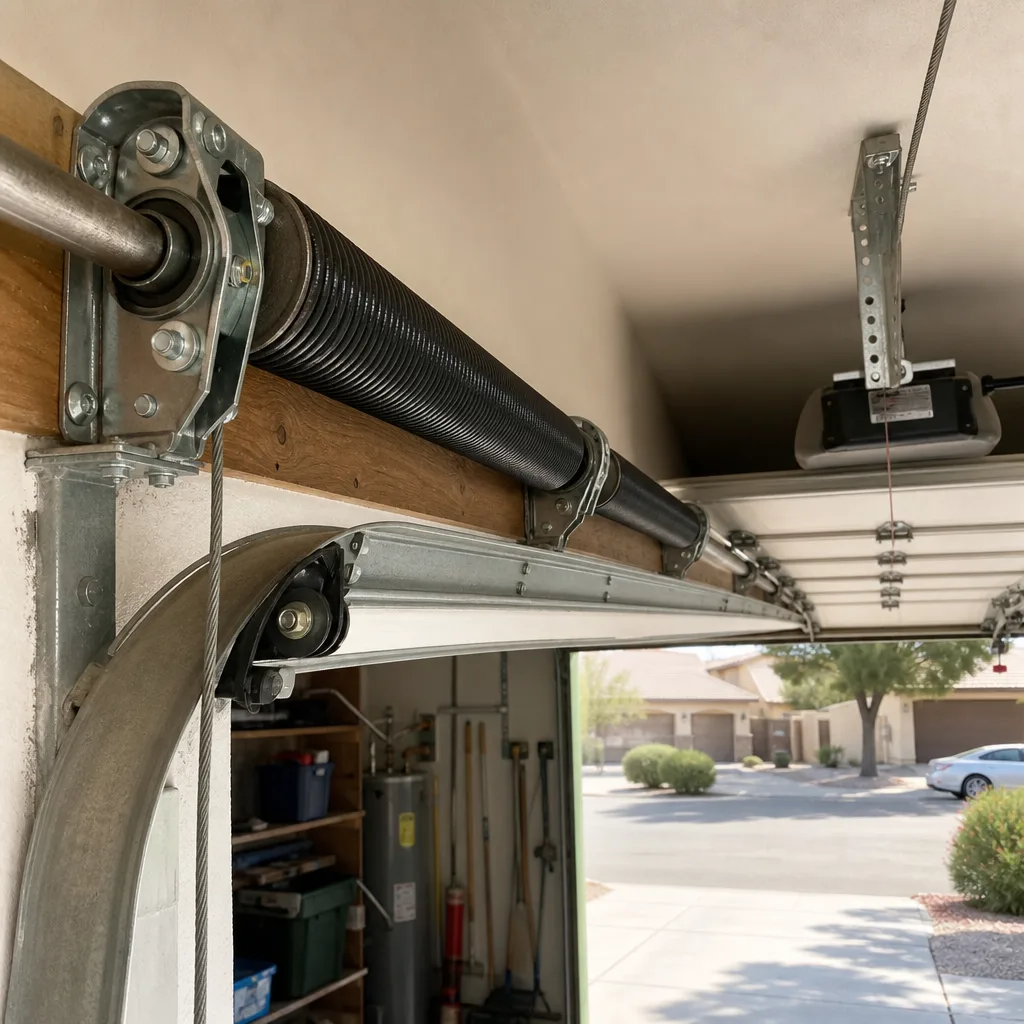
Torsion springs are the most critical component on your door, and they degrade on a predictable timeline in Mesa’s climate. The average torsion spring is rated for 10,000 cycles, which translates to roughly 7-10 years of normal use. But heat accelerates metal fatigue. A spring that’s on year 8 of its life heading into a Mesa summer is more likely to break in August than a spring in the same condition would break in a milder climate. When you inspect in March or April, you’re not just checking whether the spring is broken; you’re looking for warning signs that a break is coming.
What to look for during Phase 2:
- Rust or corrosion on the spring coils: surface rust is normal on older springs, but deep pitting or flaking means the spring is compromised. A spring that looks corroded in March is a candidate for replacement before July.
- Wear on the lift cables: the cables that run along the sides of the door and wrap around the drum should be inspected for fraying, kinking, or flattening. A frayed cable in June becomes a snapped cable in a July thunderstorm when the door is operating under stress.
- Uneven door movement: if one side of the door moves faster than the other, or the door jerks while opening, something in the tension system is out of balance. This often points to spring fatigue or cable wear.
- Track alignment: Mesa’s soil composition means some ground movement is normal over time. If your tracks have shifted even slightly out of plumb, the rollers start wearing unevenly, and that accelerates during summer expansion.
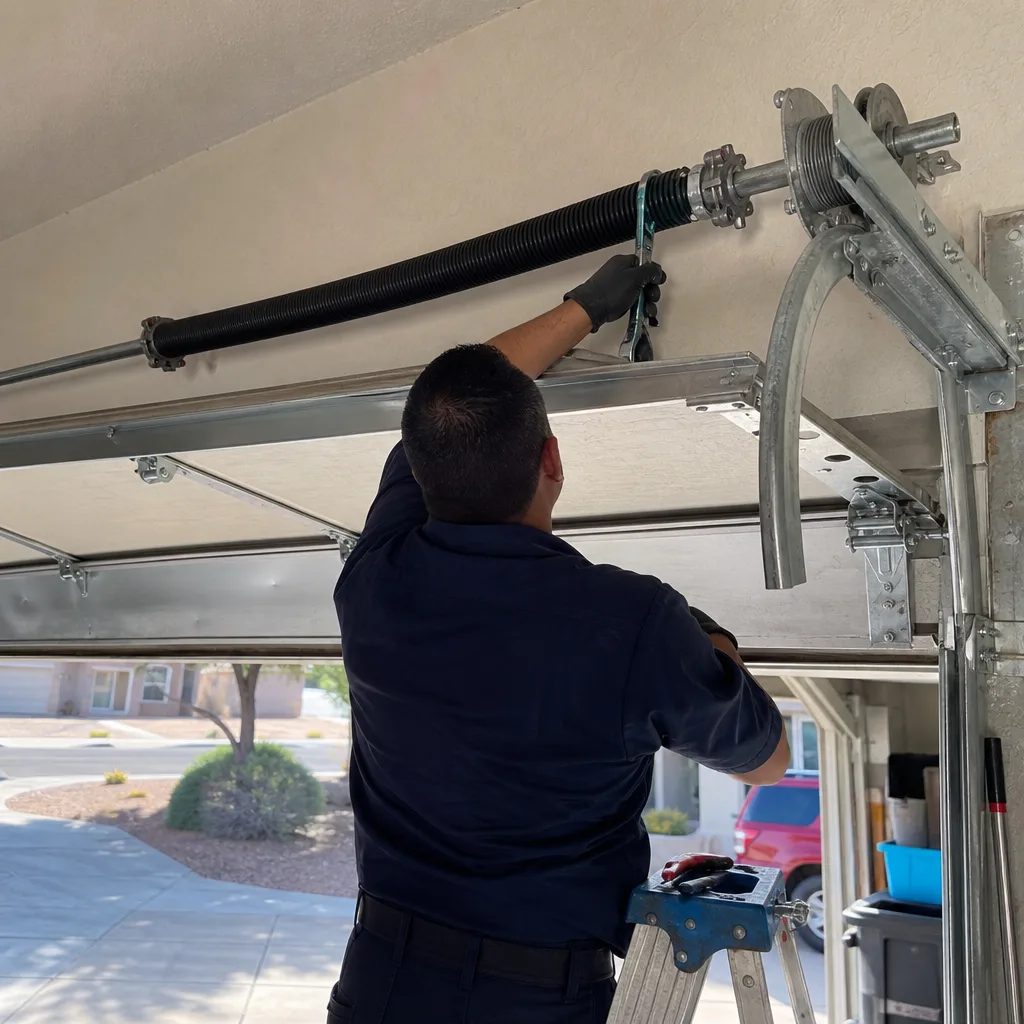
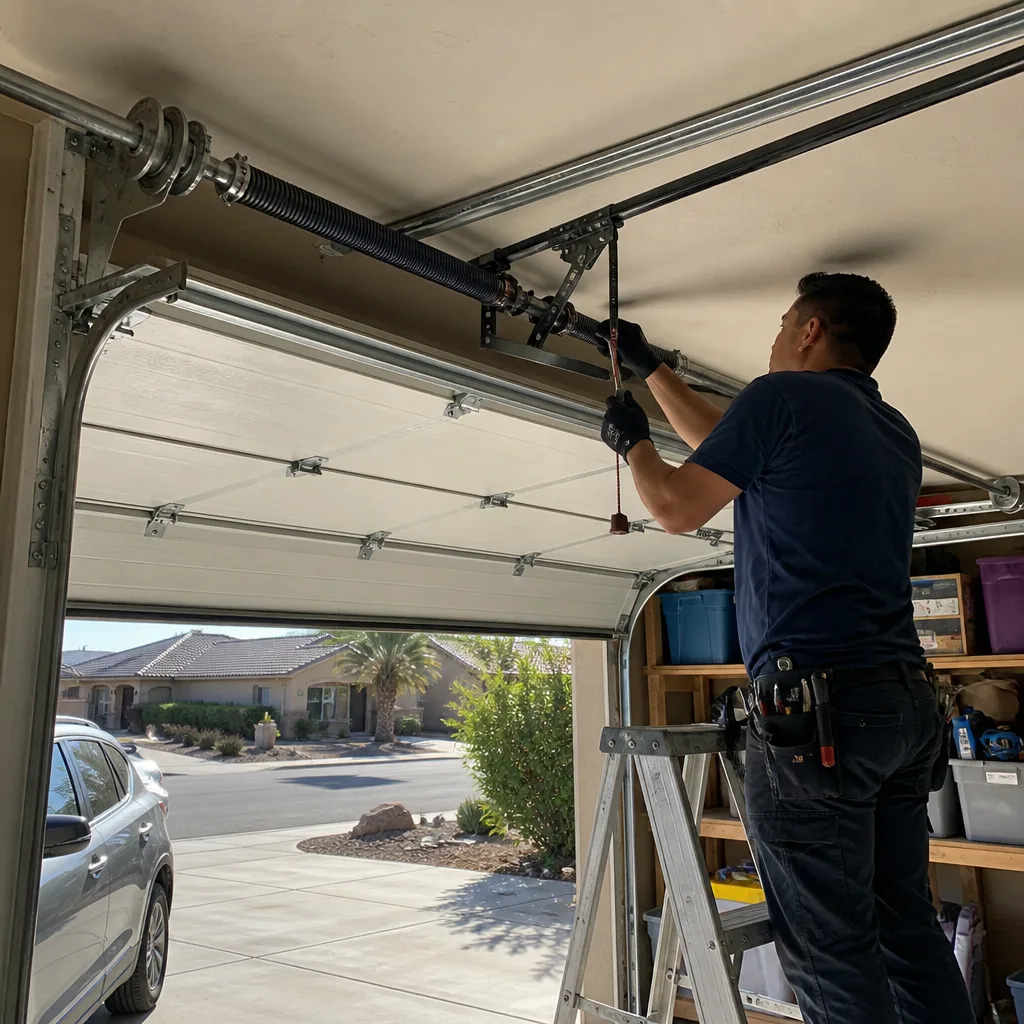
A word on safety: torsion springs are under hundreds of pounds of tension at all times, even when the door is closed. If you see a spring that looks rusted, stretched, or has a visible gap in the coil, do not attempt to remove or adjust it yourself. This is where professional service is not a luxury; it’s the only safe option. Spring tension adjustment and replacement requires special winding bars and a specific sequence that, done wrong, can cause serious injury.
If you want a professional baseline before summer arrives, Garage Door Repair in Mesa covers spring and cable inspection as part of a standard service call. We photograph the spring and cable condition and document it in a photo record, so you see the evidence with your own eyes before deciding whether replacement is necessary.
Phase 3 (July-October): Monsoon Prep and Post-Storm Recovery
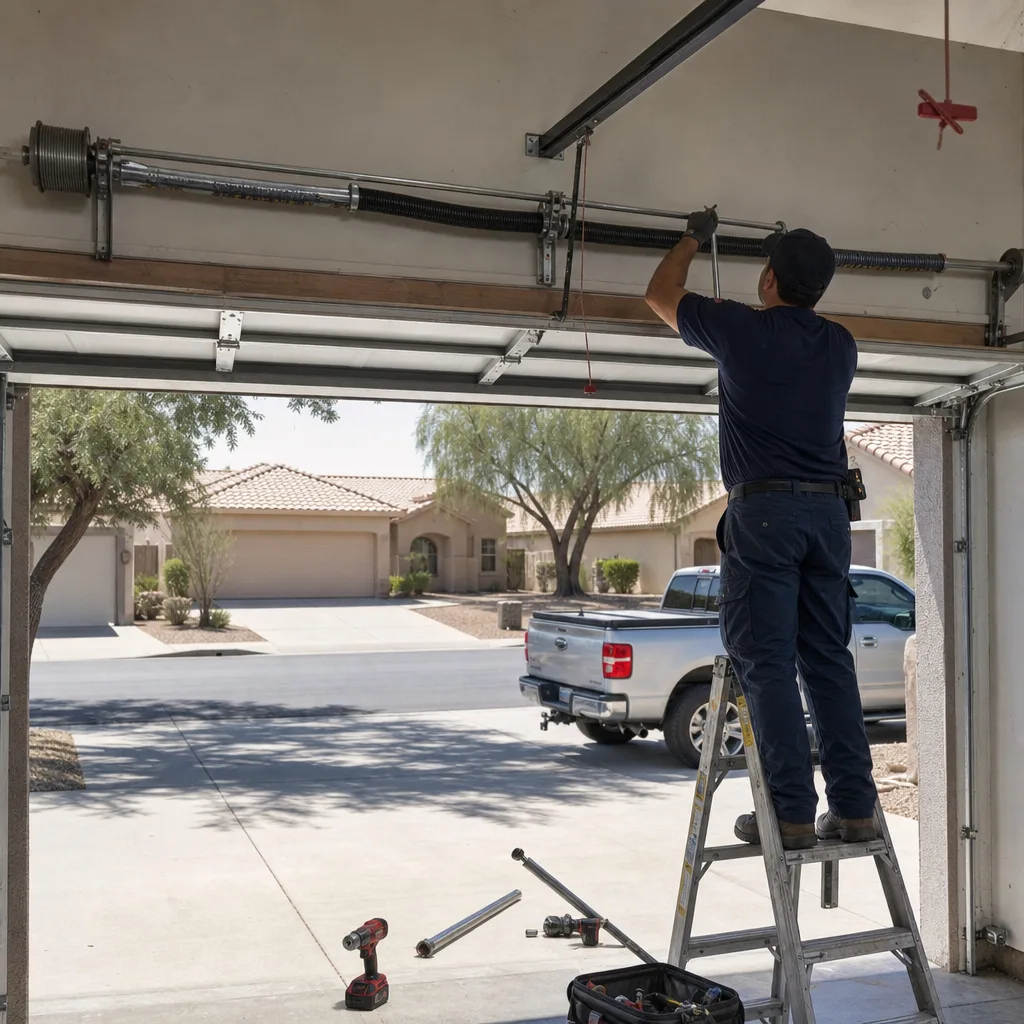
The monsoon is a specific weather event, not a season. In Mesa, the monsoon typically runs from roughly July 15 through September 30, though it varies slightly each year. What makes it uniquely dangerous for garage doors isn’t the heat; it’s the combination of sudden wind, dust, and rain after months of total dryness. That combination attacks three specific components: the bottom seal, the side and top weatherstripping, and the track fasteners.
Here’s what happens during a monsoon storm in Mesa: wind drives dust and fine sediment horizontally into your garage door tracks and hinges. Rain follows, turning that dust into a paste that grinds against rollers and lubricated joints. Then the door sits closed, and the paste dries into a fine abrasive. Repeat that cycle three or four times over a summer, and a door that was smooth in June runs rough by September.
Phase 3 breaks into two parts: pre-monsoon prep (late June or early July) and post-storm inspection (after each major event, or at minimum after the monsoon season ends in October).
Pre-monsoon prep checklist:
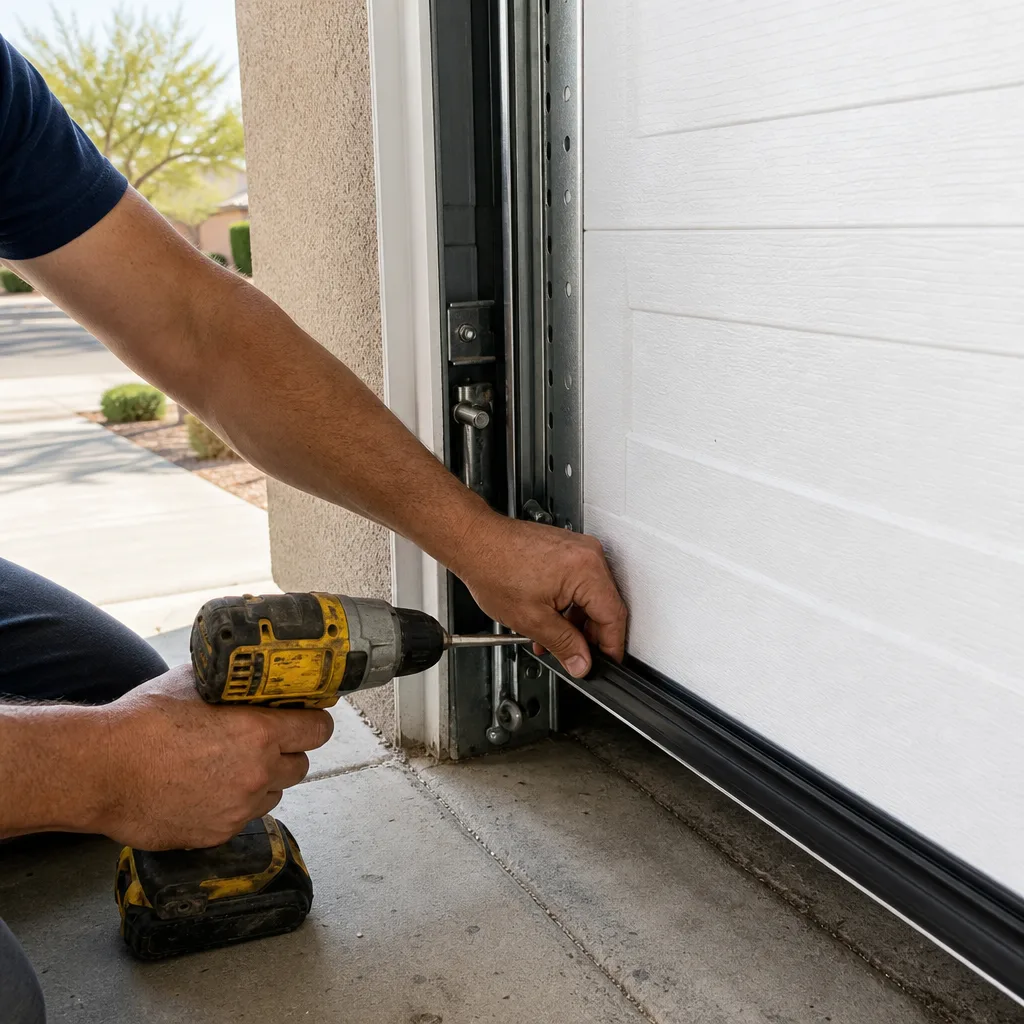
- Inspect the bottom seal: the rubber or vinyl strip along the bottom of the door is called an astragal. Look for cracks, tears, or separation from the door itself. In Mesa’s dry climate, bottom seals become brittle after 3-5 years of UV exposure. A cracked seal lets monsoon rain and dust stream directly into your garage.
- Check weatherstripping adhesion: the weatherstripping along the sides and top of the door frame is typically held in place with nails or adhesive. After a few Mesa summers, the adhesive can loosen. Run your hand along the stripping and check for gaps. Replace any sections that are peeling.
- Clear debris channels: this is the one step most guides miss entirely. Mesa homes, especially in neighborhoods like Dobson Ranch, Eastmark, and Las Sendas, often have decorative rock landscaping or gravel beds near the garage. During the windy months, small pebbles and debris can accumulate in the bottom track channels. Clear these out before the monsoon starts, because once the rains come, that debris gets compacted and becomes much harder to remove.
- Torque-check track fasteners: the bolts and screws that hold your door tracks to the wall and ceiling loosen over time, particularly in Mesa’s clay-heavy soil, which expands and contracts with moisture. A track that’s even slightly loose becomes a rattling, binding track during a storm. Use a socket wrench to snug each fastener, but don’t overtighten; the tracks are designed to allow minor adjustment.
Post-storm inspection:
- Run the door through a full cycle: open it all the way, then close it all the way. Listen for scraping, grinding, or unusual vibration. If you hear noise that wasn’t there in June, debris has likely made its way into the tracks or hinges.
- Check the bottom seal for debris: monsoon winds can wedge leaves, twigs, and small rocks under the seal. Remove anything caught underneath, and inspect the seal for tears caused by the intrusion.
- Re-check track fastener torque: post-monsoon ground movement is real. Mesa’s soil absorbs moisture quickly during a downpour and releases it just as quickly, which causes subtle shifting. Fasteners that were tight in June may have loosened slightly by September.
- Wipe down photoelectric sensors: dust and fine sediment from monsoon winds coat the sensor lenses. A quick wipe with a dry cloth restores proper function.
For more context on how monsoon-damaged doors are serviced, see our breakdown of typical repair scenarios at Garage Door Repair in Mesa.
Mesa’s Urban Heat Island and Your Opener
Mesa’s urban heat island effect is well documented. On a day when the official air temperature at Phoenix Sky Harbor reads 108°F, the ambient temperature inside an attached garage in central Mesa can easily reach 116-120°F. In newer developments like Cadence at Gateway or Eastmark, where homes are built close together and paved surfaces dominate the landscape, the differential is even higher; we regularly record garage interior temperatures 8-12°F above the official air temperature during July and August.
That heat differential has a direct effect on your garage door opener’s behavior. Most residential openers, including LiftMaster and Craftsman models common in Mesa homes, are designed with a thermal cutout switch that shuts the motor down when the unit exceeds a safe operating temperature. In practical terms, that cutout typically triggers when the opener’s internal components reach around 160-170°F.
Here’s what that means in a Mesa summer: you park your car in the garage, the car’s engine block is radiating heat from a 20-minute commute, the garage itself is already at 115°F, and the opener is mounted on the ceiling where heat accumulates most. Under those conditions, a LiftMaster chain-drive opener can hit thermal cutout after repeated operation cycles. The door stops responding, and the homeowner assumes the opener is broken when it’s actually doing exactly what it’s designed to do: protecting the motor from overheating.
What you can do about it:
- Ventilate the garage: during extreme heat periods, leaving the garage door cracked 2-3 inches or venting the garage with a small exhaust fan reduces the ambient temperature enough to prevent most thermal cutout events.
- Minimize opener use during peak heat: if you’re working in the garage or cycling the door repeatedly for yard access, that’s when thermal cutout is most likely. Limit non-essential door cycles between 2 p.m. and 6 p.m. on the hottest days.
- Check opener age: an opener that’s 10-12 years old is running closer to its thermal limits than a new one. Belt-drive units from LiftMaster and other major brands tend to run cooler than chain-drive units because the belt mechanism generates less friction.
If you’re experiencing repeated thermal cutout, it may be time for an opener upgrade or replacement. We service all major brands, and our Garage Door Opener Repair & Installation in Mesa page explains what’s involved in assessing whether your existing unit is salvageable or replacement is the better financial decision.
Component Replacement Scheduling: Buy Parts in February, Not August
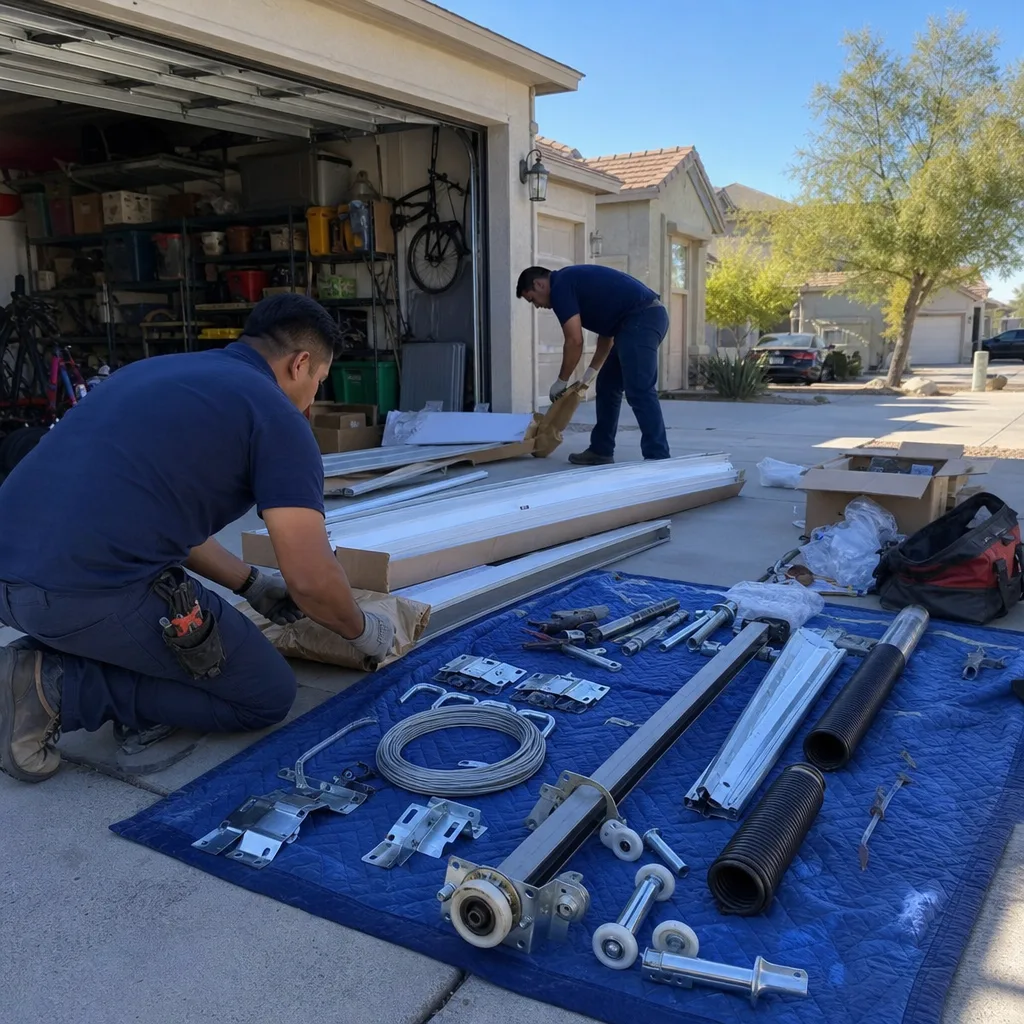
Mesa’s garage door repair market follows a predictable seasonal demand curve. When temperatures spike in July and August, and monsoon storms knock out doors across the East Valley, demand for emergency repair spikes with it. What homeowners often don’t realize is that the price variability they’re seeing isn’t just about supply and demand; it’s about the component supply chain itself.
Here’s the pattern we see every year: by mid-July, the parts distributors we work with across Phoenix are running low on common replacement parts like torsion springs, bottom seals, and roller sets. The distributors know demand is peaking. They prioritize high-volume accounts. Independent operators sometimes find themselves waiting two or three days for a part that was available same-day in February. When you add emergency service premiums to parts scarcity, the cost of a spring replacement in August really can be higher than the same replacement in February. For a full breakdown of what to expect, see our Garage Door Cost Breakdown: The Mesa Homeowner’s Reference for 2026.
This doesn’t mean you should replace parts preemptively if they don’t need replacing. What it does mean is that the mild-weather window is the best time to have an honest conversation with a technician about what’s approaching end-of-life. If your torsion spring is on year 8 of a 10-year expected life, and you’re in Mesa with a summer coming, February is the right time to replace it. You’ll get the part at normal pricing, the installation will happen in comfortable weather, and you’ll head into summer with a spring that’s not going to fail in mid-July when the wait times are longest and the garage is 118°F.
Here’s the component replacement schedule we recommend for Mesa homeowners:
- Bottom seal (astragal): replace every 3-5 years, ideally in November or December. The mild weather makes the rubber more flexible and easier to seat correctly.
- Rollers: replace every 7-10 years depending on material. Nylon rollers last longer than steel. February is ideal; the door moves smoothly in cool weather, and you’ll notice improvement immediately.
- Torsion springs: replace every 7-10 years or 10,000-12,000 cycles. Schedule the replacement during Phase 1 or Phase 2, not during monsoon season. The inspection itself is a Phase 2 task, but the decision to replace should be made before the heat peak.
- Opener: most opener models last 10-15 years. If your opener is approaching that age and you’re noticing slower operation or intermittent issues, replacing it in the mild window avoids a complete failure during summer.
- Weatherstripping: inspect annually in October after monsoon season; replace as needed. The post-monsoon inspection tells you exactly what failed so you can address it before next year’s storms.
We offer a free estimate on any of this work, and the price we quote is the price you pay. That’s not a seasonal policy; it’s how we’ve operated since 2015 under The Haven Standard. Clause 1 requires a flat, written price and written scope before any work starts, and that applies whether you’re calling us in February or August.
Common Mistakes to Avoid
- Lubricating with WD-40: WD-40 is a penetrating oil and solvent, not a long-term lubricant. In Mesa’s dry heat, WD-40 evaporates quickly and strips whatever protective residue was there. Use a lithium-based garage door lubricant instead.
- Ignoring the bottom seal until water is already inside: by the time you see water or dust streaming under your door during a monsoon storm, the seal has been failing for months. The crack that let the water in started as a small split that was visible in March.
- Adjusting the torsion spring without training: torsion springs carry hundreds of pounds of tension. The cone on the end of the spring has set screws that can strip and release under load. This is not a DIY job. We see injuries every year from homeowners attempting spring work with improvised tools.
- Waiting until the door breaks to call: by the time a torsion spring snaps, the door is often stuck in the down position with a car trapped inside. The inspection in Phase 2 is designed to catch spring fatigue before it reaches the breaking point, not after.
- Using the opener to force a jammed door: if your door is binding or stuck and you keep pressing the opener button, you’re not fixing the problem; you’re loading the motor, the gear, and the springs with stress they weren’t designed to handle. A door that doesn’t move freely by hand has a mechanical problem that needs diagnosis, not more motor force.
- Scheduling major work for July or August when it’s avoidable: sometimes a mid-summer repair is unavoidable; a spring breaks, a monsoon storm damages a panel, you deal with it. But routine replacement work is genuinely better in the mild window, both for your wallet and for the quality of the installation.
When to Call a Professional
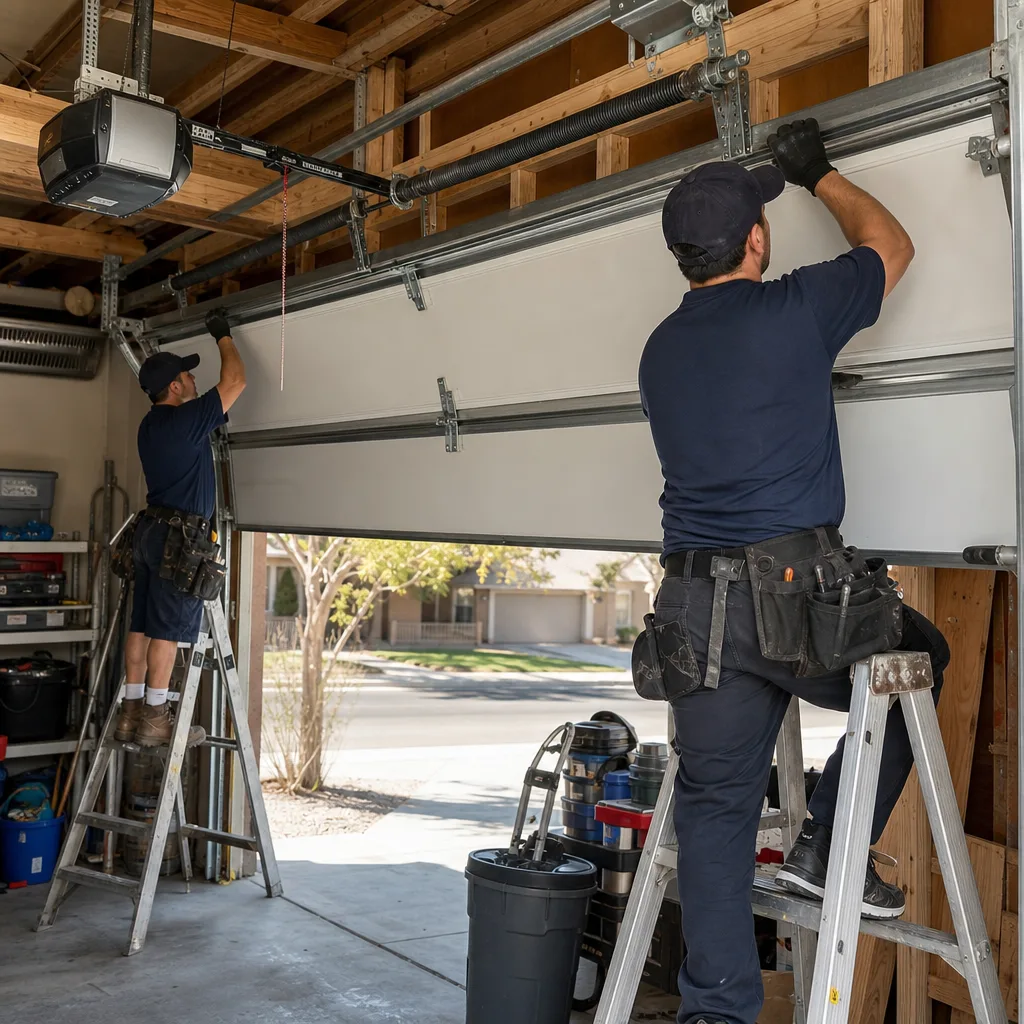
Some garage door tasks are straightforward homeowner work. Others carry risk that isn’t worth taking. Call a professional if your torsion spring shows visible signs of wear, cracking, or a gap in the coil; if your door is off-balance and drops when released midway; if the lift cables are frayed or showing individual broken strands; or if your opener is tripping its thermal cutout repeatedly despite ventilation. You should also call if you’ve been through a significant monsoon storm and notice any change in how the door sounds or moves, even if it seems minor. Small alignment problems become large repair bills when left unaddressed in this climate. Servo Garage Doors Mesa offers free estimates in Mesa; call (520) 391-9660 and Marcus Deller or a member of the team will talk through what you’re experiencing. We’re independently owned and operated under The Haven Standard, and every job starts with a written price, not a handshake.
Frequently Asked Questions
Twice a year is the right cadence for Mesa: once in November or December during the mild window, and once in March or April before the heat arrives. The mild-weather applications last longer and protect more effectively than a single summer application. Use a lithium-based lubricant on hinges, rollers (with bearings), torsion springs, and the lock mechanism. If you hear squeaking between scheduled lubrications, that’s a sign the existing lubricant has broken down, typically from heat exposure.
Yes, and it’s one of the more accessible DIY tasks on the door. The bottom seal, or astragal, slides into a retainer channel at the bottom of the door. In Mesa’s climate, the rubber dries and cracks after 3-5 years, so replacement is typically needed more often than in humid regions. The key is doing it in cooler weather when the rubber is flexible enough to slide without tearing. If the retainer channel itself is damaged, that’s a 30-minute professional fix. Call (520) 391-9660 for an exact quote; estimates are free.
That’s almost certainly thermal cutout. Most residential openers, including LiftMaster and Craftsman models, shut down internally when the motor reaches a safe operating limit, typically around 160-170°F. In a Mesa garage that’s already at 115°F, with a hot car radiating heat and the opener mounted near the ceiling, that threshold is easy to reach after a few operation cycles. Ventilating the garage and limiting door cycles during peak heat usually resolves it. If it persists, the opener may be aging out; a belt-drive unit runs cooler than a chain-drive model.
Torsion springs are rated for 10,000-12,000 cycles, which translates to 7-10 years in a typical Mesa household. Heat and dryness accelerate metal fatigue, so a spring on year 8 in Mesa is closer to the end of its service life than the same spring in a milder climate. The ideal time to replace is during the mild window (November-February) or the shoulder season (March-April), before peak summer heat arrives. Replacement should always be done by a professional; torsion springs are under constant tension and can cause serious injury if mishandled.
It’s real. The monsoon’s combination of wind-driven dust, sudden rain, and repeated wet-dry cycles attacks bottom seals, weatherstripping, and track fasteners in ways that a dry-weather summer doesn’t. The dust gets into hinges and rollers, the rain turns it into an abrasive paste, and the drying cycle locks it in place. By September, doors that were smooth in June often run rough, and bottom seals that were cracked in March have failed completely. Post-storm inspection is the most underrated maintenance task on this entire calendar.
A professional seasonal inspection with lubrication and minor adjustments typically runs $89-$149 in Mesa, depending on scope and whether replacement parts are needed. If the inspection reveals a worn spring, cable, or bottom seal, those parts are quoted separately with a flat, written price before any work starts. Servo Garage Doors Mesa quotes every job that way; it’s Clause 1 of The Haven Standard. Call (520) 391-9660 for an exact quote on your specific door and age; estimates are free and there’s no obligation.
The Bottom Line
Mesa’s garage door maintenance calendar follows the climate, not the seasons. Work with the weather: do your lubrication and roller replacement in the mild window, check springs and cables before the heat builds, and treat the monsoon as the specific threat it is, with prep in June and inspection after every major storm. The urban heat island effect means your opener runs hotter than the manufacturer’s design assumptions; ventilate and limit cycles on extreme days. When a component is approaching end-of-life, replace it in February, not August. And when a job involves torsion springs or lift cables, call a professional who documents what they find. If you’re in Mesa and want a written price before any work starts, call (520) 391-9660 for a free estimate, or browse more guides & resources on keeping your door running smoothly.
Written by Marcus Deller, Owner at Servo Garage Doors Mesa, serving Mesa since 2015.